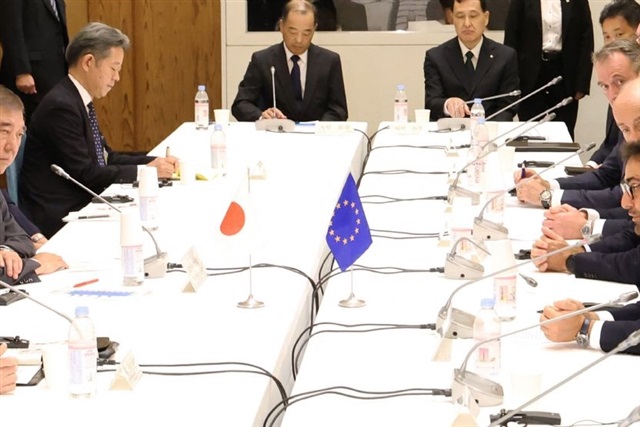
Japan and European countries are strengthening their collaboration to mitigate geopolitical tensions and supply chain vulnerabilities stemming from tensions between the US and China. On September 15, 2024, Japan's Ministry of Economy, Trade and Industry (METI) announced expanded cooperation with the European Union (EU), particularly focusing on the battery supply chain, as reported by Yomiuri Shimbun and Nikkei Asia. This move is part of broader partnerships aimed at advancing technology industries, green energy, and satellite sectors.
The new battery-focused partnership is underpinned by a memorandum of understanding (MOU) signed by an industry coalition of Japanese and EU battery companies, which formalizes joint efforts in battery recycling, raw material reuse, and data sharing across the supply chain. This initiative stems from the "Competitiveness Alliance" strategy agreed upon at the Japan-EU summit in July 2025 and represents the first concrete step toward enhancing supply chain resilience amid increasing market competition and geopolitical uncertainty.
Reducing dependence on China's battery dominance
China's influence in the lithium-ion battery market has surged, with the country's low-price strategies driving its market share to roughly 60% in 2023, while Japan's share declined from about 50% in 2015 to approximately 8%. China has also imposed export restrictions on graphite, a critical ingredient for battery production, fueling concerns in Europe about overreliance on Chinese supply chains. The rapid growth in electric vehicle adoption has heightened these concerns, prompting European battery manufacturers to pursue partnerships that could strengthen local production capabilities and reduce economic security risks.
In response, Japan and the EU have vowed to bolster their battery manufacturing sectors by adjusting subsidies, revising public procurement policies, and encouraging industrial collaboration alongside talent exchanges. These measures aim to introduce high-performance and safer battery products to the market while creating a more self-reliant supply network.
Green transformation highlights shared values and strategy
On September 16, 2024, Japanese Prime Minister Shigeru Ishiba and Stephane Sejourne, EVP of the European Commission, underscored the importance of the green transformation (GX) by witnessing the signing of another MOU between EIT InnoEnergy—the EU's largest investment fund for zero-carbon startups—and the Japan External Trade Organization (JETRO). Prime Minister Ishiba emphasized the alignment of democratic values and a rules-based economic order shared by Japan and the EU. Meanwhile, Sejourne stressed the necessity of diversified supply chains to avoid economic dependence on any single country, reflecting broader concerns over global trade security amid heightened geopolitical tensions.
Article translated by Jingyue Hsiao and edited by Jerry Chen