
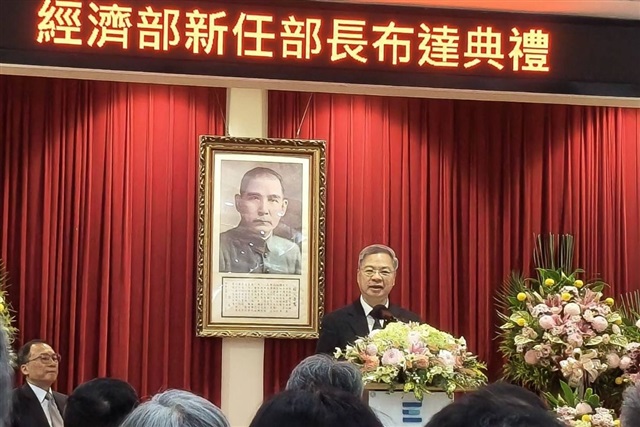
Taiwan's new economics minister, Ming-Hsin Kung, emphasized on the first day in office that state-supported organizations under the Ministry of Economic Affairs (MOEA) should actively participate in research and development tasks related to the military industry and unmanned aerial vehicles (UAVs), contributing their part to national security.
Kung delivered the message in his inaugural speech as he took the helm at the MOEA on September 1.
The MOEA has long funded several key legal entities, including the Industrial Technology Research Institute (ITRI), the Institute for Information Industry (III), the Metal Industries Research and Development Center (MIRDC), the Automotive Research & Testing Center (ARTC), the Taiwan Textile Research Institute, and the Development Center for Biotechnology (DCB). The ministry allocates annual budgets to support these organizations in technology R&D and application licensing services necessary for industrial operations.
However, following the outbreak of the Russia-Ukraine war and conflicts involving Israel against Hamas and Iran, the markets for defense, military applications, UAVs, and aerospace have seen a dramatic rise in demand, attracting interest from many businesses. Although profiting from warfare may seem unethical, without a robust military industry, it is impossible to defend freedom and democracy or counter aggressors. Therefore, companies in the military sector are in a legitimate business that is crucial to national defense. Taiwanese president Ching-te Lai's "five trusted industries" include the military industry as a critical component.
Kung expressed gratitude to his predecessor, J.W. Kuo, for leading the MOEA through challenges such as rising energy prices, industrial reshoring investments, and global strategic deployments. Addressing the so-called "five shortages" Taiwan faces, the MOEA will continue efforts to ensure no water shortage while improving water management amid climate change.
Kung stated that stabilizing power supply and reducing carbon dioxide emissions remain crucial tasks. Taiwan Power Company (Taipower) currently plans to maintain a sufficient electricity supply until 2032, and planning for post-2032 power sources must begin now. Regarding calls for extending the life of a recently shut-down nuclear power plant, Kung stressed that Taipower must first conduct safety inspections. Only with assured nuclear safety can further steps be considered.
Shift in R&D focus
Traditionally, MOEA-affiliated legal entities have focused on mission-driven applied development aimed at assisting small and medium-sized enterprises. However, given recent shifts in global geopolitics—with US President Donald Trump pressuring NATO, South Korea, and Japan to increase military spending—the global military industry capacity has expanded significantly. Even startups outside the AI sectors receive substantial investment and attention in military-related fields. Consequently, Kung's call for Taiwanese state-supported institutions to pivot their R&D aligns with current international dynamics and investment trends.
According to surveys, Taiwan's research and development expenditure accounted for 4.0% of GDP in 2023, still below Israel's 6.3%. Israel heavily invests its R&D in cybersecurity and military industries, having established a comprehensive national security industrial value chain—a model worthy of reference for Taiwan's government-backed organizations. Conversely, 91.8% of Taiwan's industrial R&D focuses on manufacturing, whereas non-manufacturing accounts for 81% in Israel, highlighting a structural difference between the two economies.
Article translated by Rodney Chan and edited by Jack Wu