
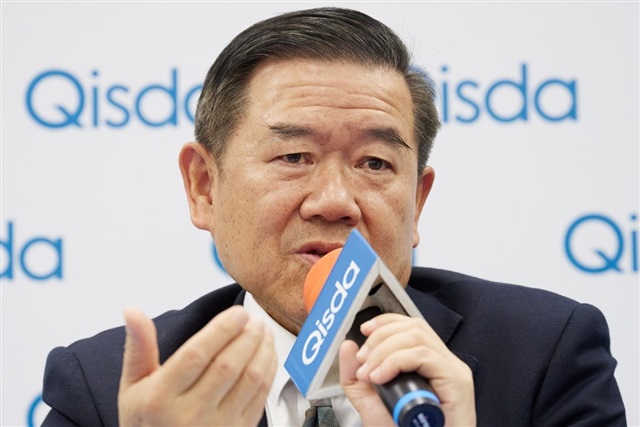
Qisda held its earnings call on August 14, revealing that its second-quarter revenue was boosted by customers pulling forward orders as a precaution against anticipated US tariffs. While this strategy increased sales in the second quarter, it also led to elevated inventory levels, further complicated by the appreciation of the New Taiwan dollar.
Currency headwinds hit margins
Chairman Peter Chen explained that a 1% appreciation of the New Taiwan dollar typically reduces Qisda's revenue by 0.7% and gross margin by 0.2 percentage points. During the second quarter, the New Taiwan dollar strengthened by 6% to 7%, which negatively affected profitability. However, management's efforts in controlling costs helped prevent more severe losses. Chen noted that the advance shipments in the second quarter will likely suppress performance in the third quarter, traditionally a peak manufacturing period, which may now only reach or slightly surpass second-quarter levels.
Section 232 probe adds uncertainty
Looking ahead, Chen highlighted uncertainties tied to the US Section 232 investigation, expected to be finalized soon. The provision targets the semiconductor and ICT sectors, critical to Taiwan's exports—accounting for 75% of shipments—and substantial US market segments. Its implementation is anticipated to drive a one-time increase in end-user prices, impacting US consumer demand in the fourth quarter of 2025. Concurrently, weakening US employment from May through July signals potential softness in consumer spending, adding further unpredictability to the latter half of the year.
Despite these challenges, Chen projected that the second half of 2025 will modestly outperform the first half, though profitability will remain volatile. The company plans to approach the remainder of the year cautiously to avoid significant profit shocks.
Medical and smart solutions drive growth
Qisda's medical and smart solutions segments achieved significant milestones in the second quarter of 2025. The medical business recorded revenues exceeding NT$7 billion (US$233 million) for the third consecutive quarter, while smart solutions hit NT$9.5 billion for the first time. These segments have become key growth drivers, accounting for 14% and 17% of revenue in the first half of 2025, respectively. Management aims for them to contribute over half of total profits by 2027.
Qisda president Joe Huang stated that despite ongoing tariff and currency challenges, the company will intensify cost control measures and enhance supply chain resilience while accelerating medium- to long-term growth initiatives.
Performance varies across divisions
During the second quarter of 2025, the information business experienced a 3% sequential revenue increase, though gross margin and operating income remained stable. The medical segment posted a 7% revenue rise, alongside improved margins and net operating income. Smart solutions demonstrated an 18% revenue growth, accompanied by improved profitability metrics. Network communication revenues increased by 26%; however, net operating income declined compared to the first quarter of 2025.
Looking to the third quarter of 2025, Qisda expects its ICT and information segments to perform better than in the same quarter last year, while medical and smart solutions will continue focusing on expansion into biomedical, pharmaceutical, computing, software, and intelligent automation fields.
Qisda financial summary | ||
Sales (NT$B) | Y/Y (%) | |
1Q24 | 46.9 | -7.0 |
2Q | 49.9 | -4.3 |
3Q | 50.8 | 0.8 |
4Q | 54.1 | 6.8 |
1Q25 | 49.7 | 6.0 |
2Q | 53.5 | 7.2 |
Source: Qisda, August 2025.
Article translated by Jingyue Hsiao and edited by Jerry Chen