CONNECT WITH US
Sign out

Taiwan aims to replicate semiconductor success with AI

, Taipei
0

Credit: DIGITIMES

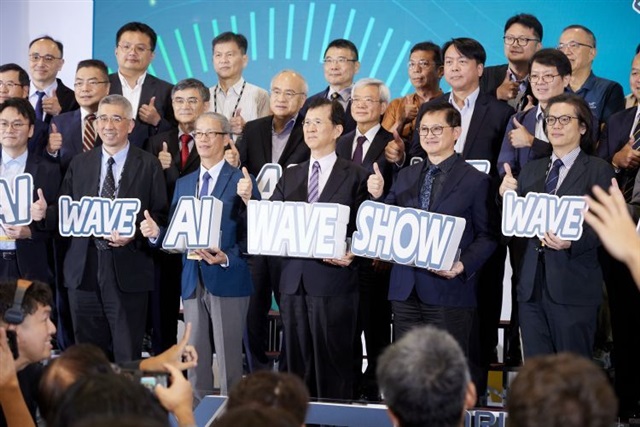
The 2025 World AI Vision Exhibition (WAVE) kicked off on July 31, 2025, in Taipei, Taiwan, organized by the Administration for Digital Industries under Taiwan's Ministry of Digital Affairs (MODA). The exhibition, also referred to as the AI Wave Show, brought together more than 200 technology companies, highlighting solutions including generative AI, large language models (LLM), agent AI, and physical AI.

Expanding Taiwan's influence with AI

Pegatron chairman TH Tung, who is also the honorary chairman of the Taipei Computer Association (TCA), attended the opening ceremony. In a speech, he said that the AI industry is "making waves" for Taiwan, just as semiconductors built Taiwan a "mountain," adding that Taiwan will not only be present in this new AI era, but will actively participate. Taiwan has already demonstrated its hardware strengths in semiconductors and ICT during the rise of AI, and he is confident that the application of AI will further expand Taiwan's influence.

Tung emphasized that semiconductors, servers, and computers, which act as the skeleton, muscles, and "nerves" of AI, will trigger a transformation in industry thinking, prompting restructuring across industries. Under the influence of AI, a new landscape will emerge; however, AI still needs to be combined with human emotions to truly change the direction of modern life, industry, and civilization.

Addressing concerns about whether AI will replace human labor, Tung believes that this wave of transformation should be seen positively. He hopes that AI will improve productivity, efficiency, and convenience in daily life, rather than replace human jobs.

Government support to build an AI powerhouse

During the opening ceremony, MODA Minister Huang Yen-nun pledged that through the Executive Yuan's 10 major AI infrastructure blueprint, more resources will be invested in computing, data, talent, and marketing to help Taiwan become an AI powerhouse. For example, in computing, cooperation with Taiwan AI Cloud is already underway to build a 40-GPU computing platform for small and medium-sized businesses and startups to use. Additional funds will be invested to expand computing power in the future.

On the data side, more companies are being encouraged to participate in promoting open data through the "Act on Promoting Data Innovation and Utilization," contributing data for training to develop sovereign AI. In terms of talent, industry-university cooperation with high schools will be strengthened. More relevant courses will also be offered at universities, with a particular focus on developing AI software talent. Regarding marketing, the government will continue to promote the AI Wave Show, which will serve as a platform for the industry to showcase technologies and products to the world.

The TCA stated that the three main areas covered by the Executive Yuan's 10 major AI infrastructure projects include smart applications, key technologies, and infrastructure. AI elements will be integrated into all areas, combining technology and future industry developments with the goal of achieving AI industrialization and industry AI-ization.

2025 AI Wave Show showcases Taiwan's AI capabilities

More than 300 AI products are being showcased at the 2025 AI Wave Show, covering AI application solutions in smart manufacturing, smart mobility, healthcare, and fintech. These solutions demonstrate how highly integrated Taiwan's AI industry is and its influence on the international market.

Participants in this year's show include domestic and international tech and consulting firms, including Advanced Micro Devices (AMD), Taiwan AI Cloud, Formosa Plastics, Taiwan Mobile, Acer ITS, Solomon Technology, Micro-Star International (MSI), Microsoft, Nexcom International, Elan Microelectronics, Systex, Ubitus KK, PricewaterhouseCoopers (PwC), Deloitte Touche Tohmatsu Limited, and EY. Solutions being exhibited include AI servers, AI computing, AI humanoid robots, edge AI, and advanced driver assistance systems (ADAS), among others.

Article translated by Eifeh Strom and edited by Jerry Chen