The trends of digitization and decarbonization within the global energy supply have made the grid edge the framework of future energy systems.

The so-called grid edge is a combination of smart grids, smart buildings, and energy producers and consumers (prosumer) through cyber-physical integration. It is a more sustainable and environmentally-friendly energy system framework.
The rise of the grid edge has also spawned new market opportunities and pushed a large number of technological and business model innovations.
According to research by the World Economic Forum (WEF), grid edge technologies could create more than US$2.4 trillion of growth in the electric power industry in the next 10 years. This transformation will undoubtedly be beneficial to the industry, as well as the environment.
The grid edge will bring revolutionary change and innovation to a number of fields such as energy trading, energy storage, buildings interconnected to the grid, sector coupling, and electric vehicle (EV) charging. These innovations together with the integration of renewable energy sources, grid stability, building, and infrastructure optimization, as well as energy-efficient industrial buildings and factories, will improve energy efficiency and help achieve sustainability goals. It will also reduce carbon emissions and reduce costs.
Buildings will play a key role under the new energy system: existing buildings consume roughly 40% of the world's energy. However, some of the energy consumed by the average building is wasted on things like unnecessarily providing air conditioning to a room that does not need air conditioning, turning on lights in a space that does not require lighting, and other wasteful energy practices.
In order to effectively reduce the occurrence of energy waste, the introduction of renewable energy and the application of digital technology in buildings has become very important. Not only can digital applications help buildings cope with the intermittency and instability of renewable energy by carrying out extra energy storage, they can also help different users within the energy system conduct more flexible power trading through software.
Digitization can effectively reduce the ecological footprint of a building by 80%, according to research. It can create more agile, flexible, and energy-efficient smart buildings that are interconnected to new energy systems. This helps to reduce operating costs of the building and raise operating effectiveness, as well as actively contribute to the energy system.
Through the integration of digitization and transformation of buildings into smart buildings and power grids, the construction of a new type of power grid framework is already being tested in several places. For example, Canada's goal is to build virtual power plants. Within this framework, the building will become a part of a distributed power plant.
The concept of a virtual power plant is mainly about merging distributed units to increase flexibility and enable participants to jointly sell the energy they produce. This allows for power generating facilities such as biogas power plants, wind turbines, solar energy, and hydroelectric plants, as well as energy consumers, power storage systems, and power-to-X plants to all be interconnected through the grid.
In theory, this means that any stakeholder in the energy market that has distributed production, storage, or consumption can become part of a virtual power plant.
Under this framework, Canada has built several heating systems, and with industry cooperation, has begun to integrate smart buildings and power grids that will store excess energy in the form of heat. The concept is to use smart buildings as a storage device for surplus power. In Canada's case, it is not just a battery that stores power, but a battery that stores heat.
At the same time, there is a need for a system that can reduce peak loads and store energy for use when there is insufficient power to monitor and regulate the entire power grid. However, in reality, the construction of similar virtual power plants is still subject to local laws and regulations before they can be developed.
Another example is the startup LO3 Energy, which established a community microgrid in the Brooklyn borough of New York City. Not only can local residents set up solar panels on the roof of their building to produce power, but they can also immediately sell the surplus energy produced by their solar panels through a blockchain-based energy trading platform.
This microgrid was mainly established to create a community of traders so that households, for example, can sell surplus power to coffee shops on the grid in exchange for free coffee. The advantage of this framework is that this extra energy can be fed back into the grid, thus allowing the community to make a contribution.
At the same time, through this framework, buildings can become a productive asset in the ecosystem. Already, many communities in both developed and developing countries have benefited from the autonomy and flexibility of microgrids. That is because in this system traditional consumers are not only consuming but also playing an increasingly larger role in energy production.
With the popularization of grid edge, I believe that buildings and cities of the future will be closely connected and integrated with power grids, energy storage equipment, and electric vehicle charging systems. In the future, power will not only be produced by power plants but also other sources such as solar panels on rooftops and wind turbines. Power will be stored in different environments such as schools and residences, even shopping centers.
This is why buildings are undoubtedly one of the key links in this new energy ecosystem. Additionally, the digitization and transformation of buildings into smart buildings, as well as the linking, cooperation, and active contribution of energy systems will help us to more quickly make smart cities and smart countries a reality.
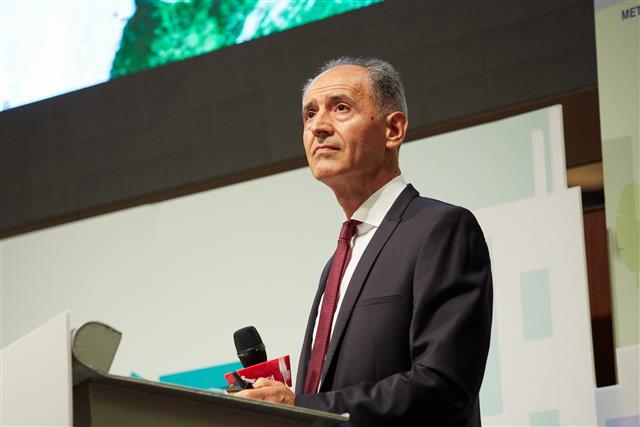
(Editor's note: Erdal Elver is president and CEO of Siemens Taiwan.)