The PC hardware industry has begun to evolve rapidly in recent years. The emergence of various hardware and software solutions and platforms has enabled hardware players to differentiate their products by venturing into the development of customized software platforms that complement their hardware designs.
After initial success designing small form factor PCs that did not compromise on features and performance, Shuttle, in 2009, re-invented itself as a manufacturing design and service provider with the launch of its New Notebook Ecosystem, and has since then continued to expand that initiative to include tablet PCs. Most recently, Shuttle has begun to build its own software solutions which has given rise to its latest development, the Edupal platform.
Digitimes recently interviewed David Chen, CEO of Shuttle, and the driving force behind the company's transformation from pure hardware designer and manufacturer, to solution design provider, as well as Jerry Yang, VP of Shuttle's Education Product Center, David Pan, GM of Desktop Business Unit, and Donald Chen, General Manager of Portable Business Unit, to discuss the company's plans for Computex 2012.
Q: Shuttle has gone through a lot of changes in recent years. What have been the driving forces behind those changes, and what sort of company would you describe Shuttle as today?
David Chen: Before Apple and Android, the IT world was dominated by Wintel (Windows software running on Intel x86 CPUs), and the only things that anyone talked about were hardware specs and costs. But now, the market has become fragmented, and the most important thing in users' minds is applications. This has posed a big challenge for Taiwan-based IT vendors, but it is also an opportunity. That's why Shuttle started its transformation and began to invest more in the business solution and education markets. These markets need complete solutions, not just devices.
Today we have three main business strategies: The Shuttle ODM business currently provides a complete notebook product line-up and during Computex we will showcase new affordable, ultra-thin designs featuring fast boot that correspond to Intel's definition of ultrabooks. We also now offer a wide range of tablet PCs available in 7-, 8-, 9- and 10-inch sizes to local OEMs worldwide. We also complement our tablet hardware offerings with software integration services for various needs.
The Shuttle desktop branding business encompasses our traditional XPC range of small form factor PCs, but we are now expanding this product range into vertical markets including digital signage, healthcare, banking, and POS, among others. During Computex we will announce a new network attached storage (NAS) product line-up, OmniNAS. We believe this product range will not only help us expand our coverage in the consumer and business markets, but long-term it will complement our other platforms. For example an OmniNAS device and XPC can be integrated with our Edupal platform to create a total solution comprising classroom server, teacher's PC, classroom NAS and tablets.
Finally our third major business strategy is the Shuttle Edupal intelligent education solution. Edupal is a turnkey solution providing hardware, software and cloud integration for the education sector. At Computex we will launch the beta version of this platform. It's worth mentioning that Shuttle is the first company to successfully build a classroom control solution on the Android platform that is also compatible and workable on Windows.
Q: So can you summarize the key announcements Shuttle will make during Computex 2012?
David Chen: We will be making three major announcements. For our Edupal range we will announce the beta release of the platform with six major functions initially.
For business solution XPCs we will launch a digital signage solution with back-end management server, a face recognition access control turnkey solution, and a Shuttle POS system designed for restaurants, bars and retail stores.
Finally we will launch the KD20, the first product in our new OmniNAS range. The KD20 is a 2-bay storage product which supports access form iPhone, iPad and Android devices.
Q: What is Shuttle's Edupal platform and how does it compare to other tablet PC platforms in the market? What are your main benefits?
Jerry Yang: Edupal is a turnkey solution comprising hardware, primarily tablet PC devices, from our ODM business unit, cloud computing services, and a complete software suite, our Interactive Learning Management System, which is a multi-platform solution that offers mobile learning and teaching tools designed to meet the needs of teachers, students and parents.
We are ready to launch this software suite as a beta release which will allow interested partners to start working with the platform. Right now the platform offers six main functions, these are:
A classroom control system which allows the teacher to monitor the progress of all students in the class as they work on their individual Edupal tablets.
A materials editing platform which gives teachers powerful functions to import edited documents from a variety of applications without spending extra time learning new operations. Moreover, the materials platform allows teachers to add multimedia content to create richer, more productive teaching content.
A personal e-book reader which supports a variety of file formats such as EPUB, Flash, HTML5, JPEG, and PNG, and provides tools that allow students to edit and write their own notes.
Our Interactive Responds [sic] System (IRS) gives teachers tools to rapidly build and maintain question banks, and to deliver in class pop quizzes with immediate feedback, and real-time analysis of student performance.
Cloud Library provides a central repository for lesson plans which can be shared between teachers, as well as in-class materials which can be delivered to students and sent back to the teacher once completed, and reading materials which can be assigned to a whole class or on a student-by-student basis.
Finally, e-contact book bridges the gap between the classroom and home by offering an effective and convenient channel for communication between parents and teachers. E-contact book empowers parents with the ability to be pro-active in their child's learning by keeping track of homework assignments, upcoming tests and test results, as well as other educational needs and progress without overburdening the teacher with an additional workload as everything is automatically updated by the system and made available online.
We also offer an app store, bookstore, interactive community, and anti-theft solution. Also we are the first one to provide a classroom control solution like this that works under Android OS.
Q: We know you have been running field trials of Edupal in schools in Taiwan, what markets you will aim to take Edupal next? How big are these markets, and what are your targets?
Jerry Yang: Our aim is to take Edupal to Taiwan and China initially where we will promote the platform under our own brand. In other markets we will look to cooperate with local OEMs and governments to provide tailor-made services.
Our key markets initially are Taiwan and China, Latin America, and other emerging markets.
We are seeing good numbers from the Classroom PC and OLPC (One Laptop Per Child) initiatives in the worldwide market, and based on that we estimate that there is potential for shipments of a few million units a year.
We see the education business as a long-term investment, and the key driver for the industry will be government bids. We started to warm-up our education business in 2010 and expect to start seeing significant outcomes during the 2013 back-to-school season.
Q: What about you XPC line of small form factor PCs for gamers and enthusiasts, will you have any new products to show?
David Pan: We will introduce two new XPCs. The SX79R5 is the world's first LGA 2011-based platform in a cube-size format, and supports the latest Intel Core i7 Sandy Bridge E series CPUs. Our new R5 aluminum chassis offers space for an optical drive, two 3.5-inch hard disks in RAID configuration and an mSATA-SSD drive in Mini-PCIe form factor, as well high-end graphics cards including the AMD Radeon HD7970 and Nvidia GeForce GTX 580.
Meanwhile our new SZ77R5 is a mainstream system featuring the Intel Z77 Express chipset and supporting 22nm Ivy Bridge CPUs, and well as native USB 3.0 ports that come with better power saving.
Q: Can you share more details about the plans to expand your XPC business into vertical markets?
David Pan: Our slim and all-in-one series XPCs have been expanded to form a flexible digital signage platform with a customized backend system that spans the requirements of any marketplace.
Our turn-key solution includes a digital signage client, server, and software offering central-control and a modular design which can easily be built up or used in a variety of environments such as an office lobby, retail setting, restaurant, hotel, public transport and other out-of-home area.
In addition we have developed a balanced POS hardware solution for small and medium businesses. Our design offers an energy saving solution based on Intel Atom processors and has a fan-less design to ensure quietness and reliability. At Computex we will showcase a new version of our 15.6-inch all-in-one PC, the X50V3, and a new 18.5 inch model, the X70, on which we will demonstrate our Basic POS, Performance POS and Basic Kiosk solutions.
We have also developed a restaurant POS solution which includes a POS terminal and tailor-made software that can be used in any type of restaurant or bar. The system provides easy order entry and effective inventory controls to help businesses enhance customer service and generate more repeat custom.
Finally we have developed a face recognition access control system which provides an easier and safer way to protect private or public assets based on our smart and highly secure Shuttle Access Control system. This system offers quick and easy operation, zero-touch identification, automatic recording, and various alarm methods (ring tone, voice, text), among other features, and can be easily integrated with existing surveillance systems.
Q: How does Shuttle's new OmniNAS product line compare to other NAS products on the market?
David Pan: I believe we provide better cost and performance. The KD20 is a budget-friendly 2-bay NAS server which is designed to provide an easy-to-use solution to store and share up to 8GB of digital assets. Not only does it support cross-platform access from Windows, Mac and Linux, it also supports access from iPhone, iPad and Android devices.
In addition, the OmniNAS also acts as print server, and iTunes server, as well as a multimedia server allowing content to be steamed directly to smartphones and tablet PCs. Finally, the KD20 supports USB 3.0 and also includes a built in 3-in-1 card reader with "Auto Copy" functionality.
Q: Who will be your target customers initially and what markets/regions will you tackle first?
David Pan: We will have two main strategies initially. In mature markets such as the US, Europe, Japan and Taiwan, we will target personal and home users, while at the same time we will also aim to attract the enterprise, SMB, and SOHO markets in the US, Europe, and emerging markets.
Q: How is Shuttle's New Notebook Ecosystem announced a few years ago progressing?
Donald Chen: We are making good progress and continue to gain support from our local OEM customers. This year we will expand our line up with new ultrabook and affordable ultra-thin notebook designs which we will be showing to our OEM customers during Computex.
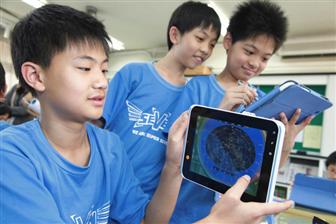
Shuttle Edupal
Photo: Company

David Chen, CEO of Shuttle
Photo: Company