

CONNECT WITH US
Sign out

Elice to build South Korea's first warm-water-cooled AI data center, unveils coding agent

Daniel Chiang, Seoul
0

Credit: Daniel Chiang

South Korean AI infrastructure provider Elice Group is expanding on two fronts, adding enterprise AI transformation (AX) solutions while building what it says will be the country's first AI data center to use warm-water cooling above 40°C.

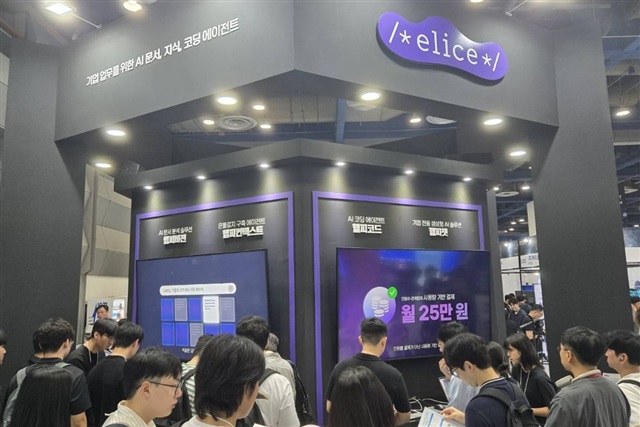
The company, which started in AI education, unveiled its Helpy Code coding agent and Helpy Context knowledge-structuring solution at the 2026 AI Summit Seoul & Expo. It also showcased its Elice AI PMDC modular AI data center and ECI GPU optimization platform.

Elice expands enterprise AX lineup

Elice's AX portfolio comprises four products spanning enterprise data reading, connection and application.

Helpy Vision, based on a vision-language model (VLM), targets unstructured document parsing. It can recognize merged cells, blank fields and low-resolution tables, as well as convert circuit diagrams and engineering drawings into structured output and generate 3D code.

Helpy Context is an ontology-based knowledge graph system that links dispersed documents, personnel and projects into a knowledge layer. The system supports real-time updates and permission controls and is designed to bridge gaps between individual and organizational knowledge.

Helpy Code is a coding agent deployed on companies' internal servers to support development tasks using internal code and knowledge. It incorporates Helpy Vision and Helpy Context capabilities and can first assess task complexity, automatically routing simpler jobs to smaller models.

The coding agent runs on high-performance open-source models validated by Elice, with the underlying model replaceable as needed. Elice says operating costs are less than one-fifth those of frontier models.

Helpy Chat provides access to multiple latest-generation AI models and includes presentation creation, image generation, and a Deep Research agent. Administrators can also control user quotas and permissions.

An Elice representative said demand for Helpy Vision is concentrated in manufacturing sectors such as electronics and automotive, particularly on factory floors, while Helpy Chat is being used across industries. In addition to private-sector customers, the product has been adopted by several public-sector organizations and extended to AI applications for teachers and schools.

For companies pursuing AI transformation, the practical usability of on-site data is a major concern, the representative said. Businesses dealing with large volumes of drawings or difficult-to-search files may need document-parsing tools alongside other AI systems.

Elice operates its services on its own security-certified cloud infrastructure and can apply domain-specific fine-tuning based on a customer's business before deploying models in closed networks to meet security requirements.

Modular data centers target 12-16 week deployment

On the hardware side, Elice is developing containerized modular data centers in which servers, cooling systems, and power equipment are prefabricated at a factory before being transported to the site for assembly.

The approach can shorten the period from groundbreaking to operation to 12-16 weeks, compared with a typical industry construction cycle of one to two years. The model is also intended to reduce the risk posed by repeated changes in power specifications as new GPU generations arrive.

Elice introduced a liquid-cooled B200 rack in South Korea in October 2025 and has sold a complete 600kW-class modular data center to a shipbuilding and marine industrial complex in Busan.

The company was recently selected to participate in South Korea's AI Computing Resource Utilization Infrastructure Enhancement program. It plans to build and operate a data center equipped with 2,560 Nvidia B300 GPUs. Elice expects the data center to be completed in November 2026.

The 2,560 B300 GPUs will be distributed across four modular data center buildings, with 640 GPUs in each. Elice is targeting a power usage effectiveness (PUE) of about 1.1.

According to Elice, the facility will be South Korea's first and one of only a small number in Asia to use warm-water cooling above 40 degrees Celsius.

An Elice representative said conventional liquid-cooling systems use chillers to lower coolant temperatures before circulating the water through server racks. Warm-water cooling can eliminate that refrigeration step, reducing overall data center power consumption.

Rising GPU costs add pressure

Supply-chain pressure remains a challenge. Rising GPU and memory prices have prompted Elice to increase prices for its cloud services.

To spread procurement risk, the company maintains multiple server suppliers. Elice is also testing NPUs from South Korean AI startups Rebellions, FuriosaAI and HyperAccel in its data centers as it looks to expand into inference workloads and reduce costs.

Elice's revenue rose 13.8% in 2025 to KRW39.5 billion (about US$28.24 million), while operating profit fell 37.3% to KRW5.2 billion.

Its portable modular AI data center business grew rapidly and was nearing 40% of total revenue. Elice is preparing for a listing in South Korea.

Higher spending on technology research and development, AI infrastructure construction, and an expanded workforce weighed on profitability. Whether those investments can translate into tangible returns remains a key question as the company moves toward a public listing.

Article translated by Sherri Wang and edited by Jack Wu
