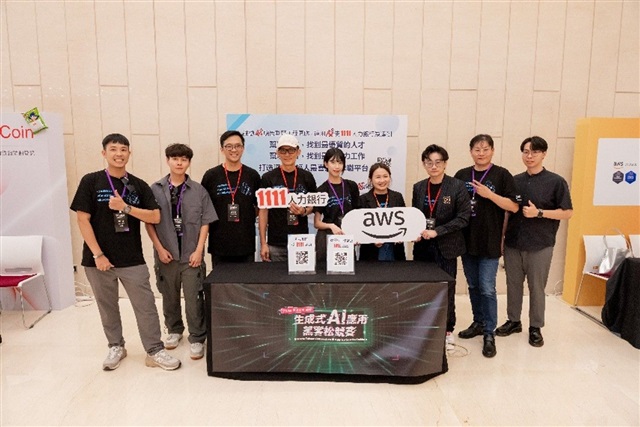
Generative AI is rapidly transforming modern work environments and recruitment practices. Traditional search frameworks built solely around job titles, categories, and keywords are now facing unprecedented challenges. To address these shifts, 1111 Job Bank participated as a challenge sponsor in the "2026 Taiwan Generative AI Applications Hackathon" - guided by the Administration for Digital Industries (ADI), Ministry of Digital Affairs (MODA), organized by DIGITIMES, and supported by Amazon Web Services (AWS) with international AI technology expertise. Setting the theme "Finding Jobs with AI Precision Matching," 1111 Job Bank invited participating teams to co-create recruitment mechanisms aligned with next-generation career models.
Deciphering True Intent Beyond Keyword Matching
Kim King, AI CEO of 1111 Job Bank, noted that emerging job roles driven by the AI wave can no longer be fully categorized under existing job classifications. Meanwhile, job seekers' expectations of search tools have been heavily influenced by interactive experiences with various generative AI tools. Consequently, recruitment platforms must develop a sophisticated capability to understand a user's "true intent."
Unlike traditional search methods that filter opportunities strictly by categories and keywords, 1111 Job Bank is evaluating the integration of resume data and on-site interaction signals into its recommendation models under strict data governance and privacy compliance. King explained that even when searching for identical keywords like "software engineer," job seekers often prefer vastly different company cultures and job functions. Keywords alone cannot capture these nuanced preferences. By factoring individual experience and user behavior into the evaluation, the challenge aimed to push job-matching accuracy to new heights.
Accelerating Algorithm Validation with Managed Cloud Infrastructure
During the competition, AWS provided cloud development environments and foundation model infrastructure. Through its fully managed service, Amazon Bedrock, teams accessed various foundation models via a unified API interface. This allowed participants to experiment with different model combinations tailored for search, intent inference, and ranking—significantly reducing the overhead of building model infrastructure from scratch and letting developers focus on algorithm refinement and real-world validation.
In the "Smart Job Search" challenge category, team "Binary Search Cannot Find the Future" earned top honors. King analyzed that the judging panel prioritized algorithmic design and practical search architecture. Although the winning team's technical architecture was not the most complex, it achieved over a 20% improvement in key metrics compared to the baseline model under the hackathon's testing dataset and evaluation criteria, earning high praise from judges. Additionally, other teams proposed innovative ideas—such as dynamic decision mechanisms driven by model confidence scores and multi-tiered search pipelines—providing 1111 Job Bank with rich insights to revisit its existing system architecture and benchmark model efficiency in production-like environments.
Bridging Industry Practice and Youth Tech Talent
Looking to future implementations, 1111 Job Bank sees the hackathon solutions as proven proof-of-concepts (PoCs) that can be further validated for stability, completeness, and recommendation quality using historical datasets. The company has already initiated experimental testing based on select participant methodologies. King highlighted that connecting job seekers with ideal roles and helping enterprises secure top talent remain 1111 Job Bank's core priorities, balancing data governance with elastic compute allocation.
At the infrastructure level, 1111 Job Bank hosts a portion of its job classification and AI inference pipelines on cloud architecture, utilizing Amazon Bedrock to flexibly allocate compute power based on data sensitivity and application needs.
The hackathon also highlighted the immense value of engaging with young technology talent. King noted that participants rapidly deconstructed complex industry problems, raised critical questions, and presented groundbreaking perspectives that challenged existing architectural assumptions. For enterprises, the competition acted as a sandbox for rapid technology experimentation; for developers and students, it provided direct exposure to real-world recruitment bottlenecks, creating a meaningful connection between technical skill and industry practice.