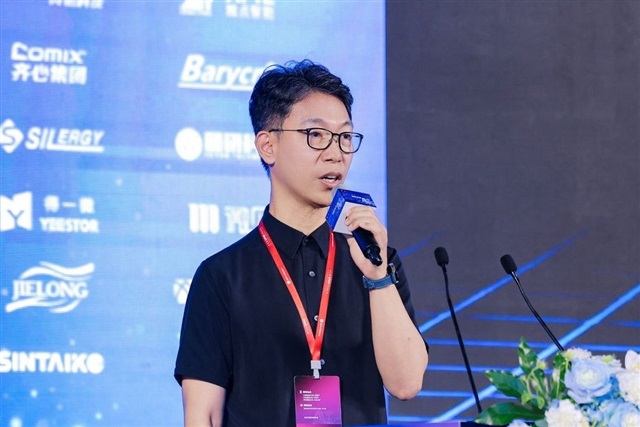
The 5th GMIF Innovation Summit (Global Memory Innovation Forum 2026;GMIF2026), co-hosted by the Shenzhen Memory Industry Association and the School of Integrated Circuits, Peking University, was recently successfully held in Shenzhen. Themed "The Future Built on AI Memory and Storage," the summit drew more than 3,000 registered professional attendees, along with industry executives and technical experts, for discussions on AI inference, enterprise storage, and cloud-edge-device coordination as AI infrastructure enters a new cycle.
Kevin Yoon, CVP & CTO of Samsung Memory China at Samsung Electronics, delivered a keynote titled "The Memory Revolution: Building the Foundation of Agentic AI." He examined the memory & storage challenges and breakthrough directions of the agentic AI era and presented Samsung's full-stack portfolio, from server SSDs to on-device zNAND-O.
Kevin Yoon noted that AI is evolving along the path from generative AI to agentic AI to physical AI, and is now moving toward the agentic stage, in which systems work through an iterative cycle of planning, acting, and reflecting to execute complex tasks. As multiple agents collaborate, they generate massive numbers of tokens, directly driving up KV cache capacity and reuse requirements.
Yoon cited data showing that frontier model training data grows about 2.9x per year, inference token usage has risen nearly 100x over the past two years, and daily token consumption in China has reached 140 trillion.
When the KV cache grows beyond what GPU memory can hold, Yoon said, an independent shared storage tier becomes inevitable, with media configured by data lifetime: pSLC (DWPD above 25) for data retained up to one hour, TLC (DWPD around 3) for up to eight hours, and QLC (DWPD below 0.2) for up to one week.
"In KV cache shared storage scenarios, the capacity, performance, and endurance of SSDs become the key considerations," Yoon said.
PM1763 and BM1773: A Two-Track Server SSD Lineup
To meet the high-bandwidth, low-latency, and large-capacity demands of KV cache shared storage, Yoon introduced two server SSDs: the performance flagship PCIe Gen6 SSD PM1763 and the capacity flagship BM1773.
The PM1763 will sample to customers in the fourth quarter of this year. It combines V-NAND TLC with a PCIe Gen6 interface and an enhanced cooling system, and Yoon said it delivers "the world's best performance." The BM1773 is built on V9 QLC, with capacity spanning 16TB to 256TB. Billed as "the world's smallest 256TB SSD," it integrates 256TB in a compact form factor, with improvements across space efficiency, performance, and reliability.
"With these two SSDs, we will drive both the performance and capacity markets," Yoon said.
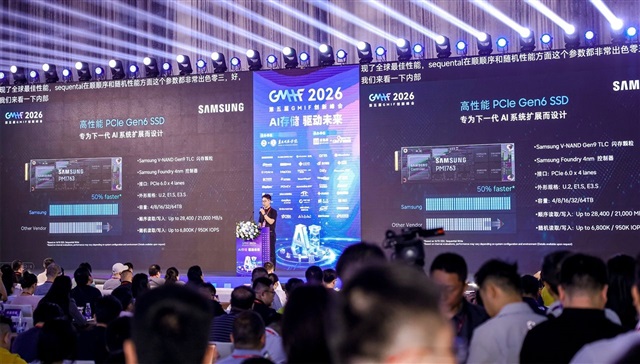
With these two SSDs, Samsung Semiconductor will drive performance and capacity markets. Credit:GMIF
V10: The Industry's First 400+ Layer V-NAND
At the NAND process level, Yoon highlighted Samsung's latest tenth-generation V-NAND product, V10 BV-NAND. Samsung has advanced vertical stacking since it introduced the 24-layer V1 in 2013, and V10 breaks the 400-layer mark, making it the industry's first V-NAND with more than 400 layers.
Compared with the previous-generation V9, V10 delivers 58% higher bit density, 33% faster I/O, and 25% lower power consumption. Yoon said the key to V10 is advanced bonding technology: the memory cells and peripheral circuits are manufactured separately and then bonded vertically, providing critical support for high-density stacking. V10 BV-NAND debuted at the FMS 2026 in the United States in August, where it won the FMS 2026 3D and NAND Innovation Award.
zNAND-O: 10x the Bit Density of DRAM for On-Device AI
Yoon closed by turning to on-device AI. AI models are expected to exceed one trillion parameters by 2030. Under the traditional unified memory architecture (UMA), where all model weights reside in DRAM, the memory cost of on-device AI would surge. Samsung's answer is zNAND-O, a next-generation high-performance NAND architecture built on its V-NAND technology and designed for on-device AI.
Versions with 4 and 8 stacked layers are currently in development, built around SLC and integrate through-silicon via (TSV) technology. The MPU and zNAND-O are co-packaged and connected through the UCIe standard interface, supporting scale-up and scale-out. zNAND-O delivers 10x the bit density of DRAM and 7x the read bandwidth and read energy efficiency of NAND flash.
Yoon presented a system simulation based on Moonshot AI's Kimi K2-1T model. At the same performance level, an NPU-optimized memory architecture using zNAND-O cut memory cost to one quarter of the original and could accommodate a model nearly twice as large.
"We believe this is the core value Z-NAND brings to customers," Yoon said.
Outstanding AI Memory & Storage Industry Leadership Award
During the summit, organizers recognized companies that made outstanding contributions to core technology breakthroughs and compute ecosystem building across the AI memory and storage chain, and announced the results on site. Samsung Semiconductor received the Outstanding AI Memory & Storage Industry Leadership Award for its sustained technology leadership in DRAM and NAND.
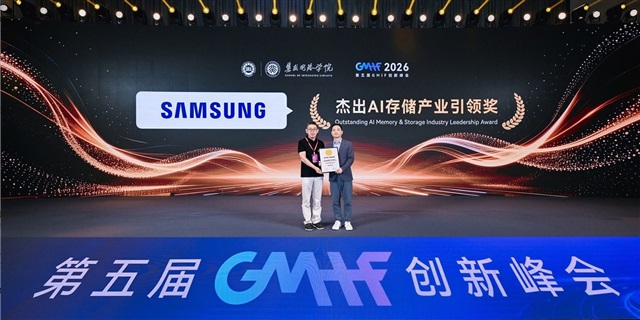
Samsung Semiconductor continues to guide the direction of DRAM and NAND technology. Credit:GMIF
Samsung Semiconductor continues to guide the direction of DRAM and NAND technology. For the agentic AI era, it has led the innovation and deployment of frontier technologies including zNAND-O 3D storage architecture, 400-plus layers V10 NAND, and CXL memory, accelerating key scenarios such as inference, large-scale compute expansion, and intelligent storage. The company provides a benchmark for the global memory industry and important support for the build-out of global AI infrastructure.
This is the second consecutive GMIF Innovation Summit award for Samsung Semiconductor. In 2025 it won the Outstanding Memory & Storage Technology Leadership Award, and it has now been recognized again this year, making it one of the memory leaders consistently honored at the summit.
GMIF2026 brought together leaders from across the global memory and storage chain, and through Yoon's keynote it showed the industry where memory and storage technology is heading in the agentic AI era. From KV cache reshaping storage tiering to the full-stack portfolio spanning 400-plus layers V10 and zNAND-O, Samsung Semiconductor has now keynoted two consecutive summits, continuing to offer the industry a technology roadmap.
On the China market, Yoon said Samsung has spent the past decade releasing product specifications and white papers to support the development of China's data center industry, and is ready to take part in any technology environment that can drive AI growth in China.