


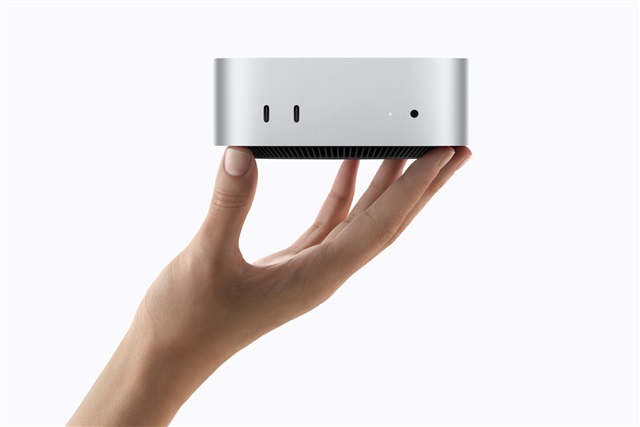
Apple unveiled new Mac mini and Mac Studio desktops on August 25 in what Reuters called "likely the final product launch of Tim Cook's tenure as CEO." The machines read less like a farewell than like a handover note. Cook becomes executive chairman on September 1, when John Ternus, senior vice president of hardware engineering, becomes chief executive under a succession Apple announced in April.
Both desktops ship on September 22 — three weeks into Ternus's first month in the job — and they commit Apple to two positions he will have to defend. The first is that the Mac has become a credible platform for running frontier AI models locally rather than in the cloud. The second is that customers will absorb the cost of a memory shortage Cook called, on his final earnings call, "a 100-year flood on the memory pricing, with exponential increases in memory prices."
What Apple actually shipped
The Mac mini starts at US$899 with an all-new M6 chip: a 12-core CPU, a 12-core GPU with Neural Accelerators built into every core, a dual 16-core Neural Engine, 16GB of unified memory configurable to 32GB, and up to 170GB/s of memory bandwidth. Apple claims up to 4x faster AI performance, 2x faster graphics and storage, and 40% faster CPU performance than the M4 model it replaces. The M6 is also Apple's first chip built on a 2nm process, according to The Verge. A step-up Mac mini at US$1,699 carries the M5 Pro, with up to an 18-core CPU, up to a 20-core GPU, up to 64GB of unified memory, and 307GB/s of bandwidth.
The Mac Studio is the more aggressive machine. The M5 Max version, at US$2,499, pairs an 18-core CPU with up to a 40-core GPU, up to 128GB of unified memory, and up to 614GB/s of bandwidth. The M5 Ultra version starts at US$5,499 with a 30-core CPU and 64-core GPU, and scales to a 36-core CPU and an 80-core GPU at US$6,800 — the first Ultra chip with Neural Accelerators in every GPU core — with up to 512GB of unified memory and 1.2TB/s of bandwidth, which Apple says is 50% higher than the prior generation. Apple puts the M5 Ultra at up to 4.3x the peak AI compute of the M3 Ultra and 9.8x that of the M1 Ultra.
Connectivity is where the AI intent shows. The Mac Studio carries up to six Thunderbolt 5 ports at 120Gb/s, and Apple says a cluster of four Mac Studio systems delivers up to 3x faster AI inference than a single machine, using Thunderbolt 5 with RDMA support. The M5 Pro Mac mini can be clustered over Thunderbolt 5 as well, though Apple publishes no scaling figure for it.
Both went up for pre-order on August 25 and reach customers on September 22, the Mac Studio across 30 countries and regions. One exception matters: the Mac Studio's 512GB unified-memory configuration — the headline specification of the launch — does not arrive until late October.
The memory bill lands on the price list
Apple has been raising Mac prices all year, and the reason is upstream. The Mac mini's US$899 entry point is US$100 above the previous price, which had itself risen from US$599 over the summer, an increase Apple blamed on memory costs, CNBC reported. The Mac Studio's Ultra tier rose to US$5,499 from at least US$5,299. The M5 Max tier held at US$2,499.
The base prices understate the effect. Apple's configuration matrix, catalogued by Daring Fireball, prices memory as the scarce good it currently is: US$400 to take the M6 Mac mini from 16GB to 32GB, US$1,000 to take the M5 Pro mini from 24GB to 64GB, US$2,000 to take the M5 Max Studio from 48GB to 128GB, and US$4,000 to take the M5 Ultra Studio from 96GB to 256GB. There is no 128GB step on the Ultra at all. Buyers who want the on-device AI capability Apple is selling pay for it almost entirely in memory upgrades, not in silicon tiers.
The pressure is documented. Memory costs accounted for more than the entire sequential decline in Apple's adjusted gross margin in the June quarter, which fell from 49.3% to 48.1%, with guidance of 47 to 48% for the September quarter, Tom's Hardware reported from the July 30 call. TrendForce expects conventional DRAM contract prices to rise a further 13 to 18% quarter over quarter in the third quarter of 2026 and NAND flash contract prices 10 to 15% — moderating from earlier quarters, but only because consumer buyers are hitting the ceiling of what they can afford.
That is the tension in this launch: Apple is pricing memory as a premium feature at the moment memory is its largest cost problem, in the product line where memory is the whole value proposition.
A desktop quietly repositioned as AI infrastructure
The strategic move underneath the specifications is a reclassification. Apple is no longer selling the Mac Studio as a workstation that happens to be fast at AI; it is selling unified memory capacity as the product, and its framing is unusually direct: the machine can run "frontier-class open-weight models" on device with complete privacy and "without counting tokens or worrying about rising cloud costs."
"Mac Studio is the ultimate desktop for on-device AI and the world's most demanding pro workflows," said Johny Srouji, Apple's chief hardware officer. "By integrating Neural Accelerators directly into the GPU and offering massive amounts of high-bandwidth unified memory, the new Mac Studio is our most powerful Mac ever."
Developers building agents with software such as OpenClaw often prefer to run them locally, CNBC reported, and Reuters framed the new Mac mini as aimed at customers looking to host AI agents remotely. Apple supplies the software layer to match: MLX, its open-source machine learning framework, and a new Core AI framework for building and deploying models on Apple silicon.
The architectural argument is straightforward: a large unified memory pool with high bandwidth suits inference on very large models better than a stack of discrete GPUs with fragmented memory, and it does so at a fraction of the power. Apple's clustering claim extends that from a desktop to a small on-premises inference tier. Apple has published no comparison against dedicated AI accelerators; the case rests on capacity and cost per gigabyte, not raw throughput.
What Ternus inherits
The Mac Pro was discontinued earlier this year, leaving the Mac Studio as Apple's most powerful screenless computer. That consolidation, plus the M5 Ultra, gives Ternus a single high-end desktop line carrying Apple's entire local-AI argument — and one already constrained. Apple's desktop supply has been tight through the memory shortage, and a 512GB configuration slipping to late October is a reminder that the binding constraint here is component availability, not design.
Ternus takes over on September 1 with the launch already announced and the orders already taken. The first genuine test of his tenure arrives three weeks later, when Apple finds out whether buyers who want to run large models at home will pay US$4,000 for the memory to do it.

Source: Compiled by DIGITIMES, August 2026
Article edited by Joseph Chen
