
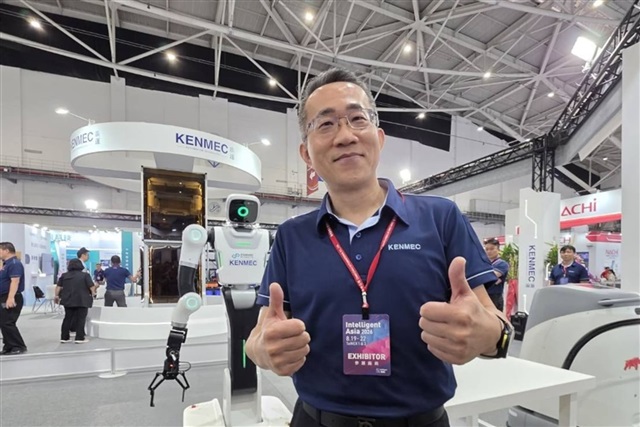
Fueled by robust global demand for artificial intelligence and the rapid expansion of semiconductor advanced packaging capacity, Kenmec Mechanical Engineering, a subsidiary of Kenmec Group, has seen its order backlog surge to nearly NT$6.661 billion (approx. US$209.1 million). Driven by this momentum, both the subsidiary and the group overall are on track to hit historic highs in revenue and order intake in 2026.
Five core business areas
Kenmec Mechanical Engineering president Chih-Chun Ko noted that the company's strategic layout focuses on five core business areas: smart manufacturing and logistics, fab automation, public infrastructure (including rail transit and airport development), AI application products, and digital twin solutions.
Semiconductors as an explosive growth driver
Among these segments, semiconductor fab automation emerged as the strongest growth engine in the first half of 2026. Kenmec successfully leveraged its deep expertise in traditional logistics to develop advanced fab automation systems, including overhead hoist vehicles (OHVs), autonomous mobile robots (AMRs), and high-efficiency material handling solutions.
Consequently, the share of semiconductor-related orders has surged from 10% of total bookings in 2025 to 30% today. The total order value in the first half of 2026 alone surpassed the full-year total for 2025, establishing semiconductors as one of the group's most explosive growth drivers.
Steady revenue from public infrastructure and rail transit
Concurrently, large-scale public infrastructure projects continue to expand. For instance, Kenmec secured a contract worth approximately NT$2.6 billion (approx. US$81.6 million) for the baggage handling system at Taoyuan International Airport's Terminal 3. With 60% to 70% of the milestone project already completed, it is expected to generate steady revenue contributions through 2027.
For the rail transit sector, Kenmec integrates AI-powered image recognition using charge-coupled device (CCD) cameras for track and facility monitoring. The system offers intelligent threat analysis within one second, triggering real-time alerts for abnormal behavior. Utilizing the NVIDIA Omniverse platform for real-time simulation and verification, Kenmec effectively bridges virtual modeling with real-world AI deployment. Having secured several government railway engineering bids, the company expects sustained long-term growth in this sector.
System integration and digital twin capabilities
In AI product distribution and robotics applications, Kenmec operates as a system integrator rather than a robot hardware manufacturer. It selects optimal equipment for specific operational environments, using deep hardware-software integration and digital twin simulation to ensure seamless deployment.
Ko emphasized that smart manufacturing, advanced semiconductor packaging, and major public infrastructure serve as the group's three primary revenue pillars. Each accounts for 30% to 40% of overall operations, providing a resilient foundation for mid-to-long-term growth.
Strong second-half outlook and global expansion
As the company enters the delivery and revenue-recognition phase for its nearly NT$6.7 billion (US$210.2 million) backlog, performance in the second half of 2026 is set to outperform the first half. Both Kenmec Mechanical Engineering and Kenmec Group remain firmly on course to achieve dual record highs in annual revenue and total orders.
Moving forward, Kenmec will continue coupling NVIDIA Omniverse digital twin simulations with robotics integration to reinforce its footprint in current automation markets. The group also plans to deepen its global expansion, paving the way for its next growth cycle.
Kenmec Mechanical Engineering generates roughly 70% of Kenmec Group's total revenue, acting as the group's key operational backbone.
Article translated by Yunnie Cheng and edited by Ysi Chen