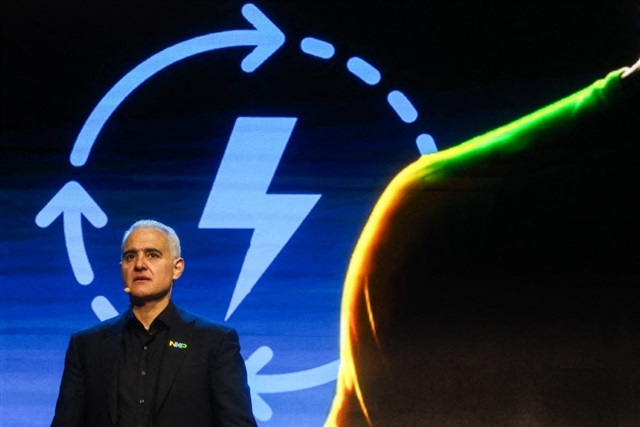
NXP Semiconductors' physical AI strategy extends beyond vehicles, factories and robots. The same control, connectivity and real-time processing capabilities are also giving the company a larger role in AI data center infrastructure, where it is targeting the systems that manage networking, cooling, security and power around increasingly complex accelerator platforms.
The company expects its data center revenue to exceed US$500 million in 2026, up from about US$200 million in 2025. Rather than supplying the GPUs that perform AI computation, NXP operates mainly in the control plane, where processors monitor and coordinate the infrastructure surrounding accelerators.
NXP's first data center franchise covers top-of-rack switching and smart network-interface-card control through its Layerscape processors. The products are being deployed by major hyperscale customers, according to CEO Rafael Sotomayor.
As networking speeds increase, he said, the processors controlling switches must handle more monitoring, management and security tasks. NXP is consequently accelerating its Layerscape roadmap to support successive generations of data center networks.
Its second franchise covers processors used to control, monitor, cool and secure individual components within a rack.
"Data center infrastructure is converging towards industrial-grade principles, where reliability, real-time monitoring and control, and zero tolerance for downtime are critical," Sotomayor said.
Those requirements resemble the conditions NXP already serves in vehicles and factories, allowing the company to apply its embedded-processing expertise to AI infrastructure at a larger scale.
The strategy broadens NXP's AI exposure beyond edge devices. AI servers require accelerators for training and inference, but they also need networking controllers, security processors, cooling management and real-time monitoring to keep increasingly dense systems operating reliably.
The Wall Street Journal reported that NXP's second-quarter growth extended across all end markets and regions, with Sotomayor highlighting software-defined vehicles, physical AI and data centers as areas of particular strength.
Orders stretch further ahead
NXP's executives also pointed to strengthening order indicators across automotive, industrial and communications markets. Lead times are extending across a growing portion of the company's portfolio, while visibility has improved into the fourth quarter of 2026 and the first quarter of 2027. NXP said its backlog provides signals extending as far as 18 months.
CFO Bill Betz said the book-to-bill ratio remained above one and had increased from the previous quarter. Customer requests for accelerated deliveries had doubled, while late orders continued to rise.

CFO Bill Betz. Credit: NXP
"A big chunk of our portfolio has extended versus last quarter," Betz said, adding that lead times for some products had moved beyond 16 weeks.
The pattern suggests customers are returning to more conventional forward ordering after a lengthy inventory correction. NXP said distributors were showing similar backlog trends, while customers that continued placing orders late were increasingly struggling to secure their required delivery dates.
However, the company drew a distinction between stronger ordering and automotive restocking.
NXP said inventory digestion was largely complete and shipments had returned to underlying demand. Western automotive Tier 1 suppliers were still ordering largely hand to mouth, constrained by working-capital pressure, rather than rebuilding inventories aggressively.
The company's automotive performance therefore reflects higher semiconductor content and new platform adoption, not customers replenishing depleted warehouses, executives said.
Memory shortages complicate recovery
While NXP's internal demand indicators have improved, shortages elsewhere in the electronics supply chain could limit customers' ability to raise production.
Sotomayor said memory constraints were already affecting parts of the market, including mobile devices. Customers were exploring alternative products, packages and types of DDR memory to work around limited availability.
"In pockets, we see it," he said.
NXP is helping customers redesign systems where possible, but shortages of complementary components could still prevent them from translating all underlying demand into finished-product shipments.
The company is also facing higher input costs for substrates, precious metals and back-end components. NXP has made selective price adjustments, although executives stressed that the measures were intended to offset inflation rather than exploit a broad supply shortage.
"This is a bit different than Covid, which was more broad-based," Betz said. "This is more of an inflationary issue."
NXP first seeks to absorb cost pressure through operational improvements. Where that is insufficient, it passes part of the increase to customers to protect margins. Executives said the adjustments were targeted rather than applied across the entire portfolio.
The combination of longer order visibility, growing customer escalations and a rising data center contribution gives NXP greater confidence entering 2027. Yet the expansion also exposes the company more directly to constraints in memory, networking and other components required to complete AI and industrial systems.
For NXP, the opportunity lies not in displacing GPU suppliers, but in controlling and securing the increasingly complex infrastructure built around them.
Article edited by Jack Wu