
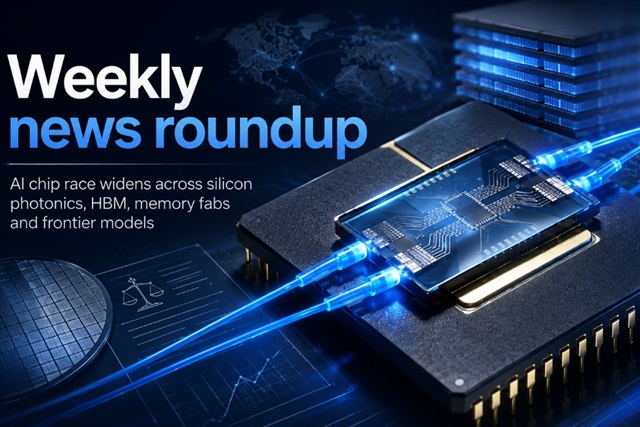
AI competition is widening from chips to connectivity, memory, talent, patents, and model access, with governments and suppliers tightening control across the stack. Below are the most-read DIGITIMES stories from the week of July 13-19, 2026.
UMC pushes into silicon photonics in Singapore to ride AI's connectivity crunch
UMC is expanding into silicon photonics in Singapore to address AI data-center connectivity bottlenecks, moving production from 8-inch to 12-inch wafers to reduce optical loss and improve efficiency. Silith Technology will be its first major customer, while a partnership with IMEC will open the platform to more clients from 2027.
UMC also plans advanced packaging services next year, an open optical-chip platform by 2028, and potential thin-film lithium niobate chiplet deployment, with more than 100 employees already assigned in Singapore. The move puts UMC into a fast-growing market alongside STMicroelectronics, Broadcom, Nvidia, and Foxconn Industrial Internet.
Korean prosecutors raid Rambus, Montage, Renesas in widening DDR5 chip probe
South Korean prosecutors raided Rambus, Montage, and Renesas on July 15 over suspected price-fixing of DDR5 interface chips used by Samsung, SK Hynix and Micron. The probe follows US searches and subpoenas, alongside a separate lawsuit accusing the three memory makers, which control over 90% of DRAM output, of inflating prices.
AI's new gatekeepers: US and China tighten grip on frontier models
The US and China are tightening oversight of frontier AI models, turning release timing, access, and technical safeguards into tools of national-security policy. Washington held pre-launch talks with OpenAI over GPT-5.6 and temporarily restricted Anthropic's Fable 5 and Mythos 5, while a June 2 executive order created a voluntary framework allowing federal agencies up to 30 days of early model access. Beijing is considering stricter launch reviews, delayed releases, foreign-user limits and tighter export controls after Chinese models including DeepSeek, Moonshot AI's Kimi K2.6 and Z.ai gained traction in US corporate workflows.
Korean court bars former Samsung NAND designers from working for SK Hynix
A South Korean court barred two former Samsung Electronics NAND designers from working for SK Hynix or its affiliates until April 30, 2027, citing their access to protected next-generation NAND technology. The July 9 injunction covers 18 months, shorter than Samsung's requested two years, and imposes a KRW5 million (approx. US$3,353) daily penalty for violations. The ruling contrasts with a separate HBM case in which SK Hynix failed to block a former employee from joining Samsung.
Hanmi, Hanwha clash in court over HBM equipment patents
Hanmi Semiconductor and Hanwha Semitech are battling in Seoul over three TC-bonder patents covering flux inspection, light wavelengths and squeegee mechanisms, while competing for SK Hynix's HBM4 orders. Hanwha is seeking KRW1 billion in damages and destruction of Hanmi's Griffin and Dragon equipment; Hanmi denies infringement. The next hearing is set for September 10. Hanmi has already secured a KRW44.2 billion HBM4 TC-bonder contract from SK Hynix, while Hanwha reportedly received a similarly sized order.
MediaTek beats Qualcomm, Samsung to secure Pixel 11's modem slot
MediaTek has secured the 5G modem slot across all four Google Pixel 11 models, ending Samsung's long-standing grip on the Pixel supply chain and beating Qualcomm in Google's evaluation. The win strengthens MediaTek's US expansion after entering the Apple Watch supply chain in 2025 and could open further opportunities in smartphones, PCs, vehicles and AI glasses, though Apple's in-house connectivity chip strategy may limit future growth.
Samsung, SK Hynix in Washington's crosshairs over memory fabs
DIGITIMES analyst Luke Lin said US pressure is mounting on Samsung Electronics and SK Hynix to build memory fabs locally, even as Korea plans more than US$500 billion in domestic semiconductor investment. He also said Intel's EUR5 billion (approx. US$5.72 billio) Fab 34 expansion in Ireland could lift capacity to 20,000–22,000 wafers, or up to 30,000 with higher utilization, but stressed that Intel's recovery will ultimately depend on capacity, yield and 14A funding from 2027.
Article edited by Jerry Chen