
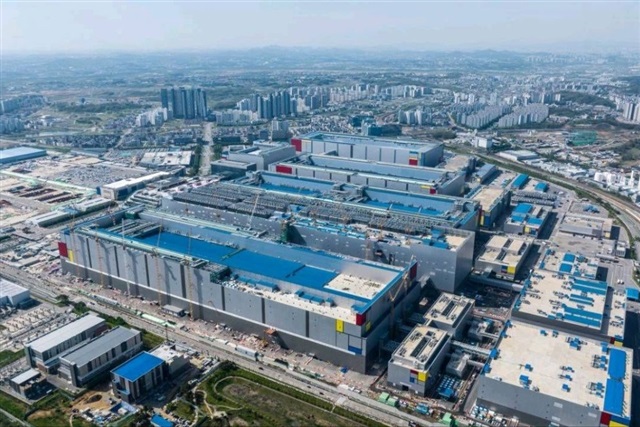
Samsung Electronics chairman Lee Jae-yong said Gwangju is being considered as a candidate site for Samsung's next semiconductor complex, lending corporate backing to South Korea's plan to build a second chip production base in Gwangju and the broader Jeolla region in the country's southwest.
Lee made the remarks on June 29 at the National Briefing on South Korea's Three Mega Projects for a Great Leap Forward at the Blue House, where President Lee Jae-myung unveiled a regional investment push centered on semiconductors, AI data centers, and physical AI, according to Yonhap.
Gwangju named as candidate
Lee said Samsung is planning around Gwangju as a candidate site because the city is expected to offer support in power, water, workforce, and other infrastructure incentives.
He said Samsung's investment schedule for the Yongin national industrial complex has accelerated significantly following earlier investments in Giheung, Hwaseong, and Pyeongtaek, bringing forward the timing for preparing a new chip complex.
Gwangju has been widely viewed as a leading candidate for the new cluster. ETNews reported that potential sites include the Cheomdan 3 district spanning Gwangju and Jangseong in South Jeolla Province, as well as the Solaseado area in Haenam. The region is being evaluated in part because of its power resources, including nuclear, solar, and wind generation.
The new complex would not replace Yongin. A senior presidential policy official said the government's position is to continue building out Yongin while creating an additional production base outside the capital region. The plan is one of addition, not relocation, with the Seoul metropolitan area facing limits in land, electricity, and water once current projects are accelerated.
Southwest to anchor four memory fabs
The broader investment framework calls for South Korea's southwest region to become a second major semiconductor production base. Industry Minister Kim Jung-kwan said the government is pursuing KRW800 trillion (US$518.4 billion) in corporate investment to build four memory fabs in the region, Hankyung reported.
Reuters, citing the South Korean government, reported that Samsung Electronics and SK Hynix each plan to build two new large-scale fabrication sites in the country's southwest as part of a national chip production ecosystem project valued at KRW800 trillion (approximately US$517.87 billion).
The plan is part of a wider effort to reshape South Korea's semiconductor ecosystem by region, with memory production in the southwest, advanced packaging in Chungcheong, and materials, components, and equipment supply-chain support in the southeast and Daegu-Gyeongbuk regions.
HBM investment goes to Chungcheong
Lee said Samsung will concentrate its HBM fab investment in the Chungcheong region, including Cheonan and Onyang, together with existing semiconductor back-end fabs.
He said high-bandwidth memory is essential for AI model training and inference, and requires advanced chip-stacking technology and production processes comparable to those used in a main fab.
That direction aligns with the government's plan to develop Chungcheong into an advanced packaging hub. The government plans to invest KRW81 trillion in the region to meet rising packaging demand as semiconductor production capacity expands.
Lee also outlined Samsung's broader regional investment plans. Robot-related investment and Samsung Group's internal AI data center will be concentrated in Gumi, North Gyeongsang Province, in connection with physical AI applications such as humanoid robots.
Samsung SDI will continue investing in next-generation all-solid-state batteries and battery energy storage systems, or BESS, centered on Ulsan. Samsung Heavy Industries will expand investment in next-generation shipbuilding in Geoje, while Samsung Electro-Mechanics will increase investment in advanced package substrates centered on its Busan plant.
Lee also said Samsung will focus investment in its bio business in Songdo, Incheon, calling bio one of Samsung's strategic businesses with strong growth potential.
"If companies, the government and local governments join forces, I am confident we can build the irreplaceable Korea the president spoke of," Lee said. "As a businessperson, I am honored to contribute."
The Ministry of Trade, Industry and Energy also plans to invest KRW30 trillion over 15 years to support the full next-generation semiconductor cycle, from R&D and design to verification and manufacturing.
Article edited by Jerry Chen
