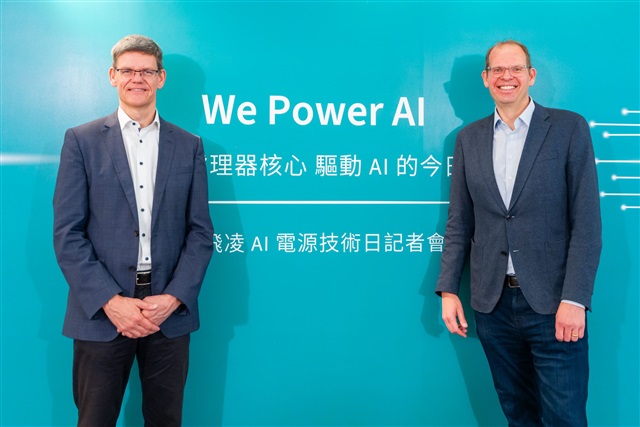
As AI data center rapidly scales toward the gigawatt (GW) level, energy management is evolving from a supporting function into a defining strategic pillar. Against this backdrop, Infineon Technologies is redefining power infrastructure of AI era through its comprehensive "From Grid to Core" strategy, integrating energy efficiency, power density, and system resilience from the electrical grid to the processor core.
Scaling AI: Strategic Power Solutions Matter
The evolution of artificial intelligence (AI) has accelerated far beyond the trajectory once predicted by Moore's Law. As AI models continue to expand in parameter scale and real-time inference becomes increasingly critical, demand for computing power is rising at an unprecedented pace.
Today, the power consumption of a single GPU is rapidly approaching the kilowatt level, and the power density of a server rack has increased significantly from less than 60kW in the past to exceeding 100kW, now moving toward a new threshold in the megawatt range.
This is not just numerical growth; it represents a fundamental shift in power architecture. As AI computing clusters expand rapidly, traditional 48V busbars and AC power distribution architectures are quickly approaching their physical limits in terms of power loss, thermal management, and spatial constraints.
Adam White, President of Infineon's Power & Sensor Systems Division, emphasized that future competition in AI infrastructure will no longer be limited to chip performance. Instead, it will be a cross-disciplinary integration battle encompassing power electronics, materials technology, and system architecture.
From Grid to Core: Rethinking the power delivery architecture
At this critical turning point for the industry, Infineon's competitive advantage lies not in a single breakthrough product, but in its ability to orchestrate and optimize the entire power delivery chain at the system level.
"From Grid to Core" is more than a product strategy - it is a multi-phase architectural framework designed to reshape the future AI energy chain. Developed through early collaboration with global hyperscalers and ecosystem partners, the strategy enables Infineon to address evolving AI power demands across every phase of infrastructure, from utility grids to processor-level power management.
Power grid: Enabling a sustainable, high-efficiency power with HVDC
At the front end of the data center, power infrastructure is transitioning from traditional mechanical systems to highly integrated solid-state solutions. Future AI facilities are expected to increasingly adopt decentralized DC microgrids, enabling greater efficiency, flexibility, and resilience in energy management.
By leveraging silicon carbide (SiC) technology in solid-state transformers (SSTs), system weight can be dramatically reduced - from nearly 20 tons to approximately 500 kilograms—while simultaneously improving overall energy efficiency by more than 1%. Beyond optimizing space utilization and operational costs, this advancement signals a broader industry migration from electromechanical infrastructure toward semiconductor-driven power systems.
As SSTs and related technologies become integrated into AI power infrastructure, a multi-billion-dollar semiconductor opportunity is emerging across next-generation energy systems.
At the same time, the power grid is evolving beyond its traditional role as just an energy source. Through digitally controlled power systems with real-time monitoring and remote management capabilities, combined with solid-state circuit breakers (SSCBs) featuring microsecond-level response times, the grid is becoming an intelligent energy platform capable of continuous optimization and predictive management.
Server rack: Reshaping power density and maximizing efficiency
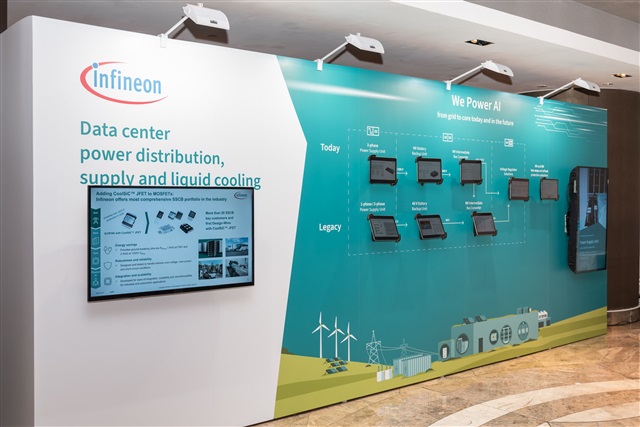
As data centers advance toward GW-scale deployments, power distribution architecture is undergoing a fundamental redesign. Infineon is driving the industry's transition from traditional 48V systems to ±400V and 800V high-voltage DC architectures. Through the design of three-phase power sidecars, Infineon is restructuring power supply and computing systems to establish a more efficient and flexible power distribution model.
At the same time, the power architecture of AI data centers is following a clear evolutionary path: moving from integrated server rack designs to high-voltage DC and sidecar power supply configurations, and ultimately advancing to gigawatt-scale infrastructures that incorporate DC microgrids.
Meanwhile, The high-frequency characteristics of gallium nitride (GaN) components enable intermediate bus converters (IBCs) to achieve over 98% conversion efficiency and exceptionally high power density in an extremely compact form factor, significantly reducing power transmission losses and freeing up more space for AI computing resources.
Processor core: Power density and new architectures for next-gen AI compute
At the processor core—the final stage of power delivery—the challenge shifts toward managing extreme current density and ultra-fast transient response.
To support next-generation GPUs requiring massive current delivery and rapid load transitions, Infineon has introduced a digital multiphase PWM controller alongside the industry's first TLVR four-phase power module. These technologies are engineered to provide highly stable, efficient, and responsive power delivery for AI processors operating under increasingly demanding workloads.
In response to the next generation of GPUs demanding ultra-high current and rapid load changes, Infineon has introduced digital multiphase PWM controllers and the industry's first TLVR quad-phase module. By leveraging high-precision telemetry and digital control technologies, power systems have transformed from energy suppliers into intelligent platforms capable of real-time monitoring, prediction, and optimization.
From AI data center to physical AI
If data centers form the foundation of AI computing power, the physical world will be where AI's true value is ultimately realized. As AI increasingly expands into humanoid robots, autonomous systems, and intelligent manufacturing equipment, demands for energy efficiency, real-time responsiveness, and system reliability will become even more critical.
Infineon is extending its long-established expertise in power management beyond data centers into the emerging era of Physical AI. By integrating sensing technologies, actuate, security and connectivity solutions, and high-efficiency power modules, the company is enabling a comprehensive functional blocks that empower humanoid robots to perceive, think, act and connect, safely and secured in a real-world environment.
Push the boundaries of power technology in AI era
"We Power AI" is not just a slogan for Infineon—it is a concrete commitment to the future of the industry. From gigawatt-scale data centers to physical AI, Infineon continues to push the boundaries of power technology, ensuring that every watt of energy is transformed into the greatest possible value for AI.
As the industry advances toward the next generation of computing, energy management will become the decisive key to truly unlocking the full potential of AI. In this wave of transformation, Infineon is joining forces with ecosystem partners to stand at the forefront of defining the future.
Editor's Note: Adam White will deliver a keynote address at COMPUTEX 2026 on June 4 titled "Infineon Powering AI from Grid to Core to Physical AI." The session will explore emerging trends and strategic opportunities in power infrastructure of AI era.
Credit: Infineon