

CONNECT WITH US

The long game of Rick Tsai: from TSMC’s darkest hour to the AI era

Joseph Chen, DIGITIMES Asia, Taipei 0

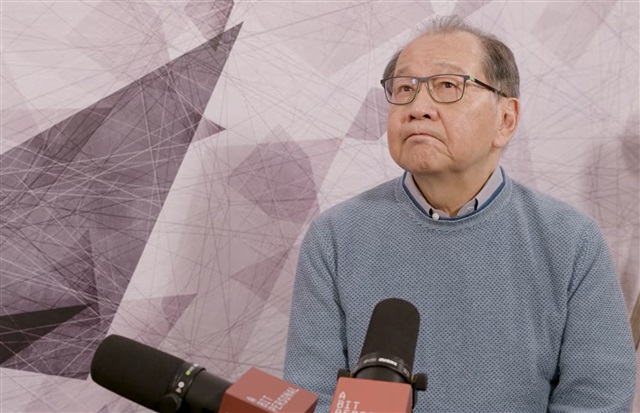
Credit: A Bit Personal with Jodi Shelton

In November 2008, Dr. Rick Tsai was the CEO of Taiwan Semiconductor Manufacturing Co. (TSMC), staring into a literal abyss. The global financial system was in freefall, and at the world’s most critical chipmaker, the lights were dimming. Utilization rates—the lifeblood of a semiconductor fab—had plummeted below 40%. Orders were vanishing.

"I remember talking to you back then," recalled Jodi Shelton, host of the podcast "A Bit Personal with Jodi Shelton," during a recent sit-down in Taipei. "You told me, 'I have no idea what revenues are going to be.'"

The interview, titled "From TSMC to MediaTek: Rick Tsai on Precision, Resilience, and the Art of the Long Game," offers a rare and deeply personal window into the life of one of the semiconductor industry’s most influential architects.

While competitors retreated during that 2008 crisis, Tsai executed a counter-intuitive maneuver that would later define his legacy. He ordered his R&D teams to accelerate. Not just to maintain, but to sprint at 110% capacity. "We were building Fab 14 at the time," Tsai explained. "I told them, 'Don't stop. We will need that capacity.'"

It was a classic "Long Game" play—a bet on the eventual return of demand that many at the time thought was suicidal. It worked. When the market rebounded, TSMC was the only player with the capacity to meet it. Today, as the CEO of MediaTek Inc., Tsai is applying that same brand of "ruthless resilience" to the $1 trillion AI revolution.

Credit: A Bit Personal with Jodi Shelton

Credit: A Bit Personal with Jodi Shelton

The McDonald’s Sacrifice

Taiwan’s current dominance in the $600 billion semiconductor industry is often viewed as a triumph of industrial policy. But for Tsai, it is a story of personal grit.

He traces the origins back to 1976, to a group of young engineers sent to RCA in the U.S. for a technology transfer program. The group included names that are now legends in Taipei’s Hsinchu Science Park: **MK Tsai (蔡明介)**, now MediaTek’s Chairman, and **F.C. Tseng (曾繁城)**, Deputy Chairman of TSMC.

In those early days, the group was so strapped for cash they famously couldn't afford a meal at McDonald's. "They made massive sacrifices for a national duty," Tsai noted. Along with Gente Liu from the Industrial Technology Research Institute (ITRI), these pioneers—backed by government visionaries Sun Yun-suan and K.T. Li—made a technical choice that would change history: they bet on CMOS technology when PMOS was the world standard. It was a marginal bet that eventually powered every smartphone on the planet.

The $1,000 Journey

Tsai’s own path was no less precarious. He arrived at Cornell University in the late 1970s with a one-way ticket and $1,000 in his pocket. A Physics graduate from National Taiwan University, he had realized early on that he wasn't the smartest man in the room. "They were way ahead of me," he admitted of his NTU peers.

That humility drove him toward practical engineering. After a decade-long stint at HP in California—where he grew "bored" of corporate stability—he followed a "gut feeling" and returned to Taiwan in 1989 to join a three-year-old startup called TSMC. He was hired by F.C. Tseng, the same man who had once counted pennies for a burger in America.

Following a "Legend"

In 2005, Tsai succeeded Dr. Morris Chang, the industry’s most revered figure, as CEO of TSMC. "Following a legend is always a challenge," Tsai said. He adopted a management style colleagues dubbed "West Pointer"—direct, military-grade discipline that brooked no excuses.

However, Tsai’s tenure wasn't without its stumbles. He is remarkably candid about the mistakes he made during the 2008 crisis, which eventually led to his departure and the return of Chang as CEO. "I made quite a few mistakes back then," Tsai admitted. "They taught me how to lead better later on."

That resilience led him to a pivot as Chairman of Chunghwa Telecom, where he learned the "operator's perspective." This proved to be his secret weapon when he took the helm at MediaTek in 2017. He saw through the hype of Millimeter Wave 5G and doubled down on Sub-6GHz. His mantra was pragmatic: "I want to make the first batch of money, not the second."

The Jensen Connection

Today, MediaTek is undergoing its most significant transformation yet: shifting from mobile connectivity to a "Computing Powerhouse." Central to this is Tsai’s 25-year relationship with NVIDIA CEO Jensen Huang.

The two have been friends since 1996, when NVIDIA was a fledgling graphics firm. Tsai recalls Huang predicting the shift toward "Computing" decades ago. Today, MediaTek and NVIDIA are co-developing chips for AI-powered automotive cockpits and PCs.

"The investment in AI data centers is an order of magnitude higher than the Internet or Mobile era," Tsai noted. While Huang is the industry’s rockstar, Tsai is the silent architect of the supply chain. "I'm not Jensen," Tsai joked, "but our engineers are learning their culture."

Credit:A Bit Personal with Jodi Shelton

Credit:A Bit Personal with Jodi Shelton

The Final Tape-Out

At the age where most executives have long retired, Tsai remains obsessed with the "Long Game." He credits his wife,*Betty, for raising their family while he pursued a 24/7 executive schedule. His nightly ritual is simple: a hot shower, a glass of red wine, and a history book.

He is still hunting for a bottle of the rare and expensive Scarecrow Cabernet from Napa Valley—simply because he’s never tried it. It’s a fitting metaphor for a man who has spent 40 years chasing the next technical frontier.

"Rick is a good guy. I enjoy working with him, and I trust him." That, Tsai says, is the only legacy that matters. In an industry defined by cold silicon and brutal cycles, Rick Tsai has proven that the most resilient component is still the human spirit.

Article edited by Joseph Chen
