CES 2026 opened on January 6 (Pacific Time), offering not only a snapshot of technology trends but also a clear signal of shifting industry power. Ahead of the show, industry watchers had widely expected Japanese and South Korean brands to scale back. DIGITIMES on-site reporting confirms that Samsung Electronics and SK Group — both major Central Hall exhibitors in 2025 — were absent from the Las Vegas Convention Center (LVCC) this year, with their former prime locations taken over by Chinese companies led by TCL.
As CES's largest and most central exhibition complex, LVCC spans mainstream consumer electronics, flagship brand showcases, autonomous driving, and smart devices. Within it, the Central Hall remains the show's most visible stage, where securing a central position translates directly into maximum exposure.
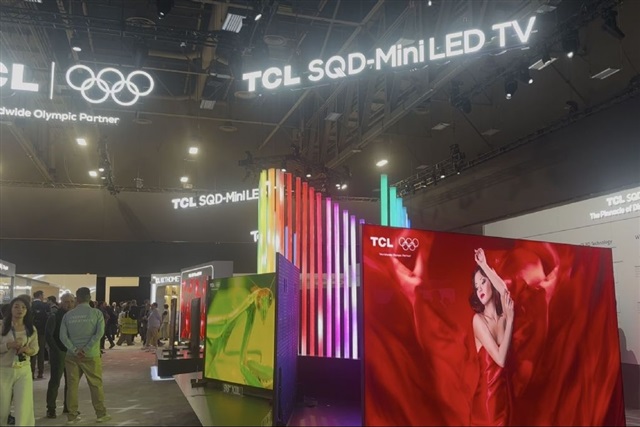
The Central Hall has traditionally hosted a three-way contest among Chinese, Japanese, and South Korean brands. In 2026, however, reduced participation from Japanese and South Korean players has turned the space into a largely China-led showcase. Beyond home appliance heavyweights Hisense and TCL, robot vacuum maker Dreame emerged as a surprise contender, moving into SK Group's former 2025 space and rising to become the third-largest exhibitor, outscaling even LG and Panasonic.
Hisense, TCL take center stage
Hisense and TCL once again drew the largest crowds on CES's opening day. More unexpectedly, Dreame matched their exhibition scale and went further by hosting two new-energy vehicle launch events on day one, marking a sharp expansion from smart home appliances into automotive manufacturing.
TCL secured the largest exhibition space at CES 2026, using an oversized entrance display to create immediate visual impact. The company devoted most of its floor space to the X11L SQD-Mini LED TV, emphasizing the combined effects of high contrast, high peak brightness, and wide color gamut. The model also made its first public debut in North America.
Hisense, meanwhile, unveiled its next-generation RGB-Mini LED technology ahead of the show, adding a fourth cyan primary color to the traditional RGB structure. The company said the new approach addresses halo issues commonly seen in conventional RGB-Mini LED panels while further improving color performance. Beyond display technologies, both TCL and Hisense also showcased immersive, AI-driven smart home experiences spanning kitchens, bedrooms, living rooms, and companion scenarios.

Hisense unveiled its next-gen RGB-Mini LED technology ahead of the show. Credit: DIGITIMES
Samsung, LG rethink TV strategies
In 2026, Samsung was absent from the LVCC main halls for the first time, instead setting up a 4,600-square-meter (1.14-acre) standalone exhibition at a nearby hotel. Its CES highlight was a 130-inch Micro RGB TV featuring a floating, tilted design aimed at maintaining optimal viewing angles from different positions.
LG also unveiled its latest OLED lineup ahead of the show, with the Wallpaper TV returning as the LG OLED evo W6. At just 9mm thick, it is the thinnest OLED TV LG has produced to date. Taken together, the moves by Samsung and LG point to a shared shift away from TV-centric strategies.

LG showcased its iconic Wallpaper TV, with a body thickness of just 9mm. Credit: DIGITIMES
Samsung has introduced Vision AI Companion (VAC) technology to its TVs, providing recommendations for viewing, dining, and music playback. Its energy-saving modes can also link with refrigerators, forming a TV-centered smart ecosystem. LG, by contrast, emphasized integration with its Smart Home AI Agent, positioning the TV as the smart home's control hub rather than a standalone display device.
Article translated by Levi Li and edited by Jack Wu