

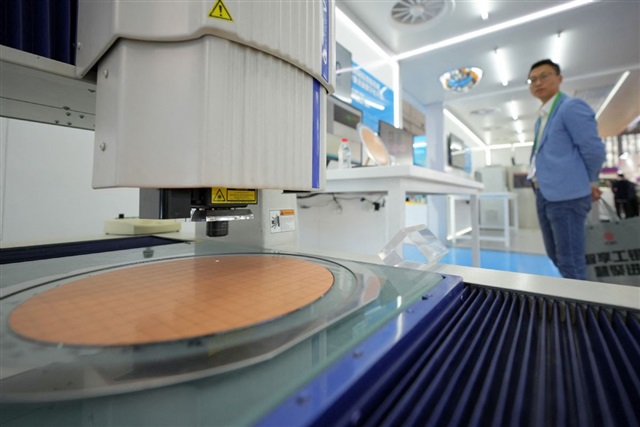
China's semiconductor industry continues to expand capacity in mature process chips while strengthening self-production of AI chips, especially as the Chinese AI sector gained momentum with the debut of DeepSeek. Due to ongoing US restrictions on semiconductor exports to China, Nvidia's AI chips have become unavailable. Although Nvidia's H20 chips were recently conditionally approved by the US government, Chinese authorities are fostering an environment that discourages the use of H20 within China.
Huawei leads domestic AI chip push
The production of AI chips centered around Huawei remains active in China. Supporting domestic AI chip manufacturers appears to be a key reason behind China's rejection of Nvidia's H20 chips.
Additionally, China's DRAM manufacturer CXMT has started mass production of HBM2 memory. Despite current challenges, CXMT is expected to begin mass-producing HBM2E by 2026 or slightly later, enabling China to achieve a certain level of self-sufficiency in HBM technology.
If China continues to promote self-made AI chips, the demand for semiconductor equipment required for producing AI chips—including HBM—will persist.
Advantest capitalizes on AI testing boom
Among semiconductor equipment suppliers, Advantest notably benefits from the AI boom. Should China maintain its investment in AI chip self-manufacturing, the demand for Advantest's high-function testing equipment in China will likely grow. While China also has test equipment manufacturers, they currently only produce lower-end testers.
Advantest's primary revenue source remains the Taiwan market, where revenue increased from JPY133.1 billion (US$902.1 million) in the first quarter of 2025 to JPY162.1 billion in the second quarter, raising its share of total revenue from 57% to 63%. This growth is mainly driven by several US IC design companies enhancing quality assurance for advanced SoCs, boosting sales to foundry operators like TSMC and related OSATs. The vast majority of Nvidia GPUs are believed to be tested using Advantest's SoC testing equipment.
In contrast, revenue from the China market declined from JPY44.6 billion to JPY39 billion, with its revenue share dropping from 19% to 15%.
Export controls uncertainty looms
However, if China continues to push for self-produced AI chips and HBM, and if test equipment is not included in US-led semiconductor export controls targeting China, there could be sustained growth opportunities for test equipment sales in the Chinese market.
Test equipment manufacturers generally find it difficult to determine which specific semiconductors their equipment tests, unlike front-end manufacturing tools that can clearly indicate whether they support production of chips at 14nm nodes or below. Overly restricting test equipment exports might disrupt supply chains.
Currently, the likelihood of including test equipment under export controls is low. Moreover, the Trump administration appears less inclined toward the regulatory approaches favored by the Democratic Party. However, given the unpredictability associated with the Trump administration, the risk of test equipment being subject to export controls to China still exists.
Article translated by Charlene Chen and edited by Jerry Chen
