
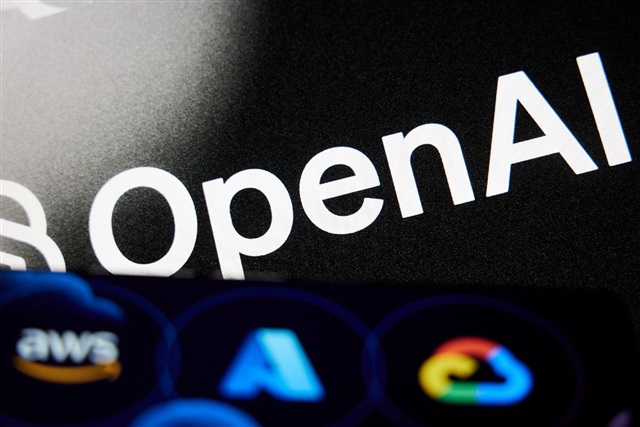
OpenAI has released open-weight models and partnered with Amazon Web Services (AWS) as a new cloud channel. This strategic move underscores US companies' determination to maintain a competitive edge in the open-source AI market against Chinese rivals. Meanwhile, OpenAI's collaboration with AWS could intensify competition for Microsoft Corp., which is working to keep pace with AWS.
Competition heats up as open models take center stage
The competition between the US and China continues to intensify, highlighting the critical importance of maintaining open models in the global landscape.
In 2025, after China's DeepSeek model gained prominence, OpenAI CEO Sam Altman admitted their closed-source strategy was a mistake and promised to release open-source models. Following various announcements and delays, OpenAI recently unveiled two open-weight models: gpt-oss-120b and gpt-oss-20b. While the training data remains private and only the weights are open, this approach matches industry standards rather than being fully open-source.
According to Artificial Analysis reports, closed-source models, including those from xAI, OpenAI, and Google, are leading, while Alibaba Cloud and DeepSeek excel among open models. Meanwhile, the influence of Meta Platforms Inc.'s Llama series has notably waned.
The White House's AI Action Plan suggests that open-source models might set global standards in some areas. OpenAI's release indicates the ongoing US focus on growing this sector.
Building an AI empire through strategic partnerships
OpenAI demonstrated its key role in the AI ecosystem by showcasing a wide range of collaborators on its website when it announced its open models.
Hardware partners include Nvidia, AMD, Groq, and Cerebras. Distribution partners feature Microsoft Azure, AWS, Hugging Face, vLLM, Ollama, llama.cpp, LM Studio, Cloudflare, Databricks, Fireworks AI, Together.ai, Vercel, Baseten, and OpenRouter.
AWS CEO Matt Garman and Microsoft CEO Satya Nadella expressed support for OpenAI's open models on social media. AWS highlighted in a press release that its platform offers superior cost-performance for these models compared to competitors like Google Gemini and DeepSeek R1. This partnership also provides OpenAI with access to millions of AWS customers.
AWS views OpenAI as a vital model provider alongside DeepSeek, Meta, and Mistral AI, but hasn't clarified whether OpenAI will use its Graviton or Trainium chips. With AWS's significant investment in Anthropic, the impact of collaborating with OpenAI on this existing partnership remains uncertain.
Microsoft highlighted the capabilities of its Azure AI Foundry and Windows AI Foundry platforms, particularly their support for edge computing through Foundry Local on CPUs, GPUs, and NPUs. The company noted that open-source models have become mainstream, allowing users to fine-tune and optimize them easily. The gpt-oss-120b model, for instance, can operate on a single enterprise-grade GPU, handling large-scale cloud inference and agent-type tasks at the edge.
AWS primarily offers OpenAI's open weight models, while Microsoft incorporates a wider range of the latest OpenAI models into its services, showcasing more extensive collaboration.
Cloud wars enter new phase
OpenAI has recently turned to Google Cloud for resources. While Google CEO Sundar Pichai is eager to expand this collaboration, questions persist regarding the extent of their partnership and how Google will manage the competitive dynamics.
Google Cloud's Vertex AI platform includes OpenAI's gpt-oss models, though Google Cloud hasn't publicly emphasized this feature.
As OpenAI collaborates with all three major cloud providers, its rising dominance is reshaping the initial phase of generative AI, disrupting the earlier trend of cloud giants partnering with various AI startups.
OpenAI currently allocates resources unequally among partners, posing a challenge for cloud leaders like AWS and Microsoft, who must differentiate their offerings to compete effectively.
Article translated by Jingyue Hsiao and edited by Jerry Chen