
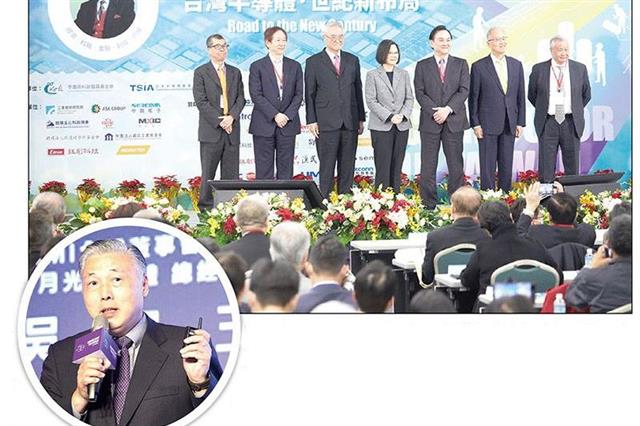
Taiwan's semiconductor sector has performed outstandingly amid the pandemic over the past two years thanks partly to its strong industrial clusters, but Taiwan needs to advance to "Cluster 2.0" in response to new qualitative and quantitative changes in semiconductor competition, particularly from IDM 2.0 and semiconductor ecosystem reconstruction in China, according to Tien Wu, chief operating officer at ASE Technology.
Wu said Taiwan's semiconductor industry has led the world in market development, division of labor, sustainable development and customer trust, but industry players must make advance deployments to counter new competition environment in the next decade.
Wu made the remarks when speaking at a tech forum recently hosted by KT Li Foundation for Development of Science and Technology.
While semiconductor talent shortage will become a new norm in the next 10 years, the emerging IDM 2.0 or China's efforts to rebuild its semiconductor ecosystem will also be posing new competition pressure to industry players in Taiwan, Wu said. This, coupled with growing geopolitical issues arising from increasing US-China rivalry, may necessitate an upgrade of semiconductor clusters and a new integration of industries in Taiwan, he continued.
The pandemic has sparked unexpectedly explosive semiconductor demand for healthcare, digital transformation and other new applications, which has led to price hikes in the entire semiconductor supply chain for the first time ever, Wu said, adding that flexible inventory adjustment in practice for decades are no longer applicable as a result.
Furthermore, partial semiconductor investment projects seen in the past are now replaced by investment increases in all semiconductor segments. In terms of foundry alone, while 32 foundry fabs worldwide are set to be completed in the near future, another 53 new fabs are already on the drawing boards, according to Wu.
Wu noted the semiconductor industry will be experiencing new qualitative changes, including inflationary effect, greater market segmentation spurred by complicated geopolitics issues, new production cost from mounting calls for green manufacturing and zero carbon emissions, and increasing need to use AI and automation technologies to counter talent shortage.
Additionally, system makers are keen on developing increasingly complicated designs to enhance their product differentiations and secure higher profits, which in turn will pose challenges to vertical and horizontal division of labor, ushering in a new milestone for industrial cooperation and system integration, Wu said.
From the perspective of quantitative changes, he continued, the overall semiconductor supply capacity will stay tight throughout 2022, and whether the situation will persist into 2023 will depend on market value and the extent of equilibrium then.
Wu concluded that semiconductor players in Taiwan will see more opportunities than challenges in the next 3-5 years, given that their clients tend to focus on innovations and high-growth domains and have high trust on them. And in the longer term, they should join forces with supply chain partners and global terminal clients to maximize their overall values.
Article translated by Willis Ke