As retail, logistics, e-commerce, and food services accelerate digital transformation, feature-packed mobile applications have created unexpected barriers for seniors and digitally vulnerable groups. Confused by cluttered interfaces and complex menus, many older users rely heavily on family members or store clerks, causing high-value corporate digital platforms to suffer lower-than-expected adoption rates.
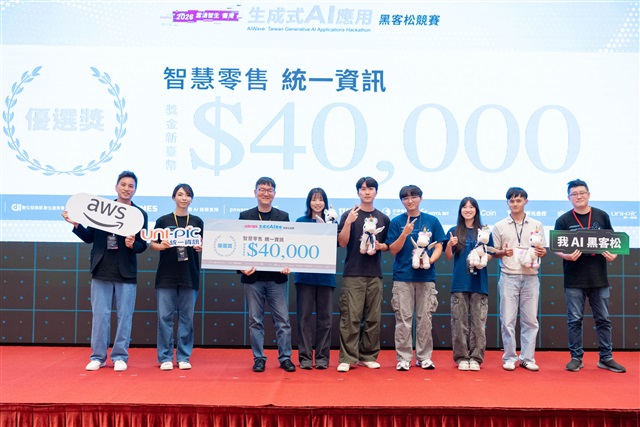
Addressing this pain point, team "Zhengxing Heartbreaker" engineered "AI Butler," a generative AI-powered service platform designed to replace manual app navigation with intuitive voice conversations. Competing in the "President Information Corp.: Smart Retail" category, the team earned top honors at the 2026 Taiwan Generative AI Applications Hackathon, organized by DIGITIMES under the guidance of the Administration for Digital Industries (ADI), Ministry of Digital Affairs (MODA). Amazon Web Services (AWS) served as the AI technology provider, delivering the generative AI and cloud services that powered the solutions.
Two Modules, Five Core Capabilities for Universal Accessibility
The platform's breakthrough lies in converting multi-step digital workflows into natural spoken dialogue. Integrating two core operational modules and five key features, "AI Butler" supports voice input, speech synthesis, senior-friendly interfaces, Taiwanese language recognition, order sharing, and lunar calendar date processing. By supporting natural speech patterns across age groups, the system eliminates traditional reading and navigation hurdles.
Senior-centered accessibility sits at the heart of the platform's architecture. The team optimized visual contrast, font sizes, voice responsiveness, and local language support to enable older adults to handle daily errands, check orders, and make reservations effortlessly via conversation. For busy working professionals, "AI Butler" serves as a unified gateway, handling everyday logistics without the hassle of switching between multiple standalone apps.
Human-Centric Engineering Drives Hackathon Victory
The team attributed its success to a zero-learning-curve philosophy - designing interactions so intuitive that users can navigate services naturally without training. By analyzing real-world usage scenarios across demographic segments early in the hackathon, the team iteratively refined its interface hierarchy and conversational flows.
Members noted that intense cross-functional collaboration during the 30-hour sprint allowed them to deliver a fully functional prototype. The hands-on experience in generative AI deployment, local speech processing, and inclusive UI design provides a strong foundation for future commercial development and tech competitions.