

At least one of the US Air Force's most secretive drones, the RQ-170 Sentinel, may have supported the US operation on January 3 that saw the capture of Venezuelan President Nicolas Maduro and his wife, according to foreign media reports and analysis by defense observers.
Video taken by local spotters in Puerto Rico appears to show an RQ-170 returning early January 4 to Roosevelt Roads Naval Station, also known as Jose Aponte de la Torre Airport. The site has served since September 2025 as a hub for expanded US military activity in the Caribbean, giving US forces access to the Caribbean Basin and northern South America that analysts say suits regional surveillance and support missions.
The US Air Force acknowledged the existence of the RQ-170 about 16 years ago but has released little about its deployments. Open-source estimates cited by defense analysts place the fleet at roughly 20 to 30 aircraft. Sightings outside test ranges are uncommon, reflecting the platform's role in sensitive intelligence missions.
Built by Lockheed Martin's Skunk Works, the RQ-170 is designed for persistent intelligence, surveillance, and reconnaissance against high-value targets. Its core design is more than two decades old, and it is not considered the most advanced low-observable aircraft in service. Analysts say it remains effective for covert, long-duration monitoring, including in contested airspace.
Sensors and emissions control
A key feature of the RQ-170 is its reliance on passive sensors. Unlike reconnaissance aircraft that emit radar or communications signals, the drone operates under emissions control, or EMCON, enabling it to collect signals and electronic intelligence without revealing its position. Analysts also say it carries synthetic aperture radar capable of producing high-resolution imagery through clouds, vegetation, and darkness.
The aircraft is believed to be fitted with a stabilized electro-optical and infrared turret housing visible-light and thermal cameras. Those sensors can transmit real-time full-motion video over secure data links to mission control centers. The RQ-170 is unarmed, and analysts emphasize that it is intended to support precision strike platforms and special operations forces with targeting intelligence rather than carry out attacks.
Operational analysis and network role
Defense outlet Army Recognition has assessed that the RQ-170 can loiter above 15,000 meters, placing it beyond the reach of many air-defense radars while mapping defensive positions, surface-to-air missile sites, troop concentrations, and electronic emitters. The same assessment says live video feeds could give senior decision-makers, including then-President Donald Trump, continuous visibility into operations.
Analysts also point to a less visible role as a data relay within the US airborne ISR network. The aircraft's stealth characteristics and communications links allow it to pass sensor data to airborne command platforms such as the E-11 Battlefield Airborne Communications Node, or BACN, and to ground commanders. That capability supports distributed targeting even when communications are degraded.
Precedent deployments
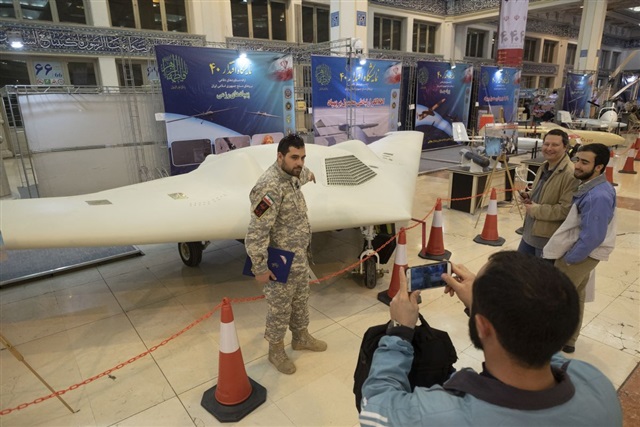
Reporting by The War Zone says the RQ-170 has been used to monitor Iran's nuclear program, showing its value in sustained surveillance of denied areas, despite the loss of one aircraft in 2011. Analysts also assess that it has operated from South Korea on missions near North Korean airspace, has been deployed elsewhere in the Pacific, and may have flown over the Black Sea in 2022 and 2023 to collect intelligence on heavily defended Russian positions in Crimea.
Drawing on those precedents, analysts say the RQ-170 may have monitored Venezuelan military bases and other targets tied to the reported US action, while also supporting post-operation assessments. The Air Force has previously disclosed tests pairing the RQ-170 with B-2 bombers for battle damage assessment, reinforcing its role in post-strike intelligence rather than direct combat.
Article translated by Sherri Wang and edited by Jack Wu