
Taipei, Sunday, May 19, 2013 06:44 (GMT+8)
mostly cloudy
Taipei
26°C
AMD launches micro servers with AMD Opteron and Intel Xeon processors
Press release, September 11; Joseph Tsai, DIGITIMES [Tuesday 11 September 2012]

AMD has announced the availability of three products for the fabric computing, micro servers and data center technology segments. The first is a new chassis, AMD's SeaMicro SM15000 server, which extends fabric-based computing across racks and aisles of the data center to connect to massive disk arrays supporting over 5PB of storage capacity. In addition, AMD announced a new generation of compute cards for its micro servers based on AMD Opteron and Intel Xeon Ivy Bridge-based processors. These products continue the AMD tradition of providing industry-leading density, power efficiency and bandwidth for tomorrow's data center, the company said.

The SeaMicro SM15000 micro server, with its patented Freedom Fabric, enables the disaggregation of data center infrastructure. In combination with the newest generation of processors from AMD and Intel, it provides the highest performance-per-watt, the highest compute density and highest storage density, as well as the most bandwidth-per-unit compute of any micro server, AMD claimed.

With the new AMD Opteron processor, AMD's SeaMicro SM15000 provides 512 cores in a ten rack unit system with more than 4TB DRAM and supports up to 5PB of Freedom Fabric Storage. Since AMD's SeaMicro SM15000 server is ten rack units tall, a one-rack, four-system cluster provides 2,024 cores, 16TB of DRAM, and is capable of supporting 20PB of storage. The new and previously unannounced AMD Opteron processor is a custom designed octal-core 2.3GHz part based on the new "Piledriver" core, and supports up to 64GB of DRAM per CPU.

AMD's SeaMicro SM15000 server is the first micro server to support the latest generation of Intel Xeon processors based on the Ivy Bridge microarchitecture. The Intel Xeon Processor E3-1265Lv2 is a 2.5/3.1GHz quad-core processor that supports 32GB of DRAM. A SeaMicro SM15000 server configured with 64 Intel Xeon Processor E3-1265Lv2 CPUs provides 256 cores and 2TB of DRAM.
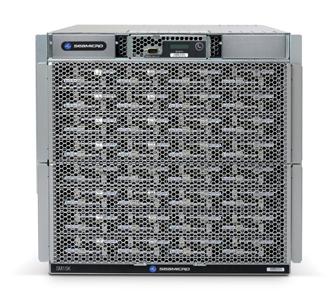
AMD SeaMicro SM15000 server

AMD SeaMicro SM15000 server
Photo: Company

17-May-2013 markets closed

 LastChange

TAIEX (TSE)8368.19-21.86-0.26% 

TSE electronic316.17-0.60-0.19% 

GTSM (OTC)119.56+0.49+0.41% 

OTC electronic143.91+0.93+0.65% 

MSI GK-601 Mechanical Gaming Keyboard
Smartphone industry and market, 2013 forecast
2013 TFT LCD industry and market outlook
  • Taiwan notebook ODMs

    Taiwan notebook Original Design Manufacturers (ODMs) account for more than 90% of global notebook production and Digitimes is there to provide daily...

  • Android

    The early success Google's Android platform has achieved in the handset market has caused system makers, software developers and semiconductor players...

  • Windows 8/RT operating system to bring new changes to the IT industry

    As Microsoft launched its latest Windows 8 and RT operating system, there are many players already launched the related products, while some expect the...

  • Watch out for Apple, Google and Microsoft tablets

    As Apple, Google and Microsoft are all expected to release new tablets in near future, smaller tablet brand vendors may have trouble trying to survive...

  • 2H 2012 global TFT panel market forecast

    Digitimes Research predicts there will be a total of 389 million large-sized TFT LCD panels shipped in 2H12, with 195 million in the third quarter and 194 million in the fourth quarter - with the total representing a 7.6% increase over the first half of this year.

  • Trends and shipment forecast for 2H 2012 smartphone market

    Smartphone shipments in 2010 and 2011 both enjoyed growth of more than 60%. Growth will decelerate in 2012 due to the high base, as well as a slowdown in consumer spending in Western Europe.

  • Trends in Asia LED chip manufacturing industry

    Asia is playing an ever more important role in upstream LED chip manufacturing. The region accounted for 80% of MOCVD demand in 2011 and will account for 90% in 2012, largely because Taiwan, Japan, South Korea and China are the major global centers for LED chip production.