
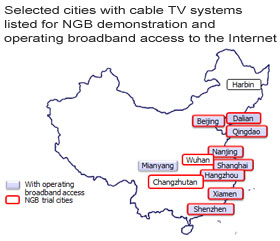
Network convergence combining telecom, broadcast and Internet on a single platform to deliver voice, data and video content to devices has already begun in China and trial services are operating in a number of cities, but China's broadcast operators and telecoms have their own areas of business and run different services on their own networks and terminal equipment so issues remain.
This Digitimes Research Special Report examines the major players, government guidelines and market segments shaping triple network convergence in China in 2012.
Chinas triple-network convergence policies and development in 2010
Chart 1: Triple-network convergence policies: focus of observation in 2011-2012
Chart 2: TV broadcast and telecom industries differ in ecosystem
Chart 3: Promotion of triple-network convergence in two phases with five core tasks
Table 1: Basic network conditions in 12 cities when selected for trial operations
Chart 5: Telecom carriers' IPTV services in the 12 trial cities
Trial operation for triple-network convergence proceeding without breakthrough
Approval of Beijing proposal marks starting point for triple-network convergence
Chart 8: Milestones in cities selected for trial operation-1
Chart 9: Milestones in cities selected for trial operation-2
Chart 10: Milestones in cities selected for trial operation-3
Chart 11: Milestones in cities selected for trial operation-4
TV broadcasters and telecom carriers in Wuhan, Shenzhen, Nanjing poised for cooperation
Chart 12: Milestones in cities selected for trial operation -5
Chart 13: Milestones in cities selected for trial operation-6
Second-round selection of cities for trial operation to kick off
Table 2: Hangzhou, Shanghai IPTV operational models before trial operations in China
Chart 15: SARFT-planned framework of integrated IPTV platforms
Chart 17: Yunnan model: CNTV's IPTV operation after trial operation began
Chart 18: Number of IPTV subscribers by province in China, 2010
Chart 19: Possible future modes of IPTV development under triple-network convergence in China
Chart 20: Digitalization trend of cable TV and number of users, 2011
NGB is the infrastructure through which SARFT will push back against the telecoms carriers
Shanghai will complete construction of five-million user NGB network within three years
Chart 26: Timeline of Shanghai's development of NGB networks
Jiangsu's model for cable network integration provides valuable lessons for other provinces
Unexpectedly slow progress on two-way cable networks in China
The enhancement of content services is the next step in building NGB for broadcasters
Chart 27: Project 136 furthers the development of NGB in China
CMMB coverage reaches 100% in prefecture-level cities in 2011
The creation of TD-CMMB is a result that gives both CSMBC and China Mobile what they want
CMMB TV content continues to evolve but is still insufficient to support a paid service system
Chart 29: Service content for China's CMMB mobile TV service
CMMB mobile phone TV will grow rapidly in 2012 following its inclusion in service bundles with TD
Changes and trends for networks and channels resulting from convergence
Rise of video websites due to dissatisfaction with conventional TV
SARFT begins to monitor piracy under triple-network convergence policies
Chart 31: Strategies for protecting intellectual property of video content
Licensing regulations take effect in 2011, pushing up copyright fees
Table 3: Copyright prices of TV dramas sold to web video sites
Direct broadcast satellite radio/TV: Penetration to villages
Chart 33: China's development of radio/TV penetration to villages in phases
Chart 34: Areas under trial use of public direct broadcast satellite radio/TV service
Chart 35: STB demand in China, 2006-2011 (k units, accumulated)
Chart 36: Functions of direct broadcast satellite STBs developed by SARFT
STBs lead to cooperation between TV broadcasters and telecom carriers
Table 4: Subsidies under trial use of public direct broadcast satellite radio/TV service
200 million farming households to be potential market for triple-network convergence
TV broadcasters step into web video operation through connected TV
Chart 37: User bases, penetration and growth in China market of web video service, 2H07-1H11
Internet TV stations lag behind private video websites in visit volume
Chart 39: Revenues from advertising on web video, growth and main sources, 4Q09-2Q11
Chart 40: Ranking of web video portals in China by traffic of visits
Chart 41: Anhui Internet TV station's home page and home page for its web video service
Expansion of user base becomes top goal for Internet TV stations
Chart 42: CNTV under CCTV sets first goal of hiking visiting volume
