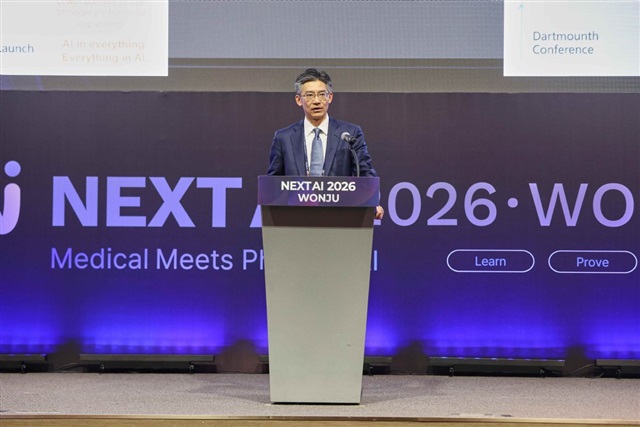
Xunfei Healthcare (iFLYTEK Medical), the healthcare AI arm of China's iFlytek, is using its Spark Medical Large Model to support diagnosis and medical record generation while tackling challenges including clinical workflow integration, differences in care settings, and model hallucinations. It also hopes to bring its experience from China to South Korea through local partnerships.
The robotics industry has come a long way since robots were first built over 50 years ago. Yet LEACHIM, a robot teacher and one of the world's first humanoids created back in the 1970s, may hold a key clue as companies seek to transition their technological advancements into on-the-ground deployment: develop machines that solve real-world problems.
Liquid cooling in AI data centers is moving toward more granular control architectures. Patrick Zeng, general manager of data center thermal management at Texas Instruments (TI), told DIGITIMES that as next-generation GPU computing power and rack power continue to rise, thermal management will shift from centralized control by a CDU to independent control for each server tray, a shift that will increase the use of sensors, drivers, MCUs, and other components within each rack.
Spanish semiconductor metrology startup Wooptix, whose technology originated in astronomical observation, is accelerating efforts to enter the supply chains of leading semiconductor foundries.
Surging AI-driven chip demand has extended order visibility for Zeiss, a key supplier of extreme ultraviolet (EUV) lithography optics. Christoph Hensche, president of Zeiss Semiconductor Manufacturing Optics (SMO), told DIGITIMES in an exclusive interview that demand for 2026 and 2027 is already clearly defined, with production capacity at Zeiss and some other manufacturers fully booked for the coming years.
Singapore is targeting high-value semiconductor manufacturing, advanced packaging, and silicon photonics, building on its strengths in engineering, precision manufacturing, and reliability, according to Zeng Yi Wong, assistant managing director for manufacturing at Enterprise Singapore (EnterpriseSG).
Singapore is moving its AI strategy beyond pilot-heavy experimentation toward a more deployment-focused model centered on enterprise adoption, sector transformation and resilient access to compute.
The semiconductor industry reached the US$1 trillion revenue milestone several years earlier than originally forecast, and with growth driven by AI and quantum computing, reaching US$2 trillion by 2035 is entirely achievable, SEMI President and CEO Ajit Manocha told DIGITIMES in an exclusive interview at SEMICON West 2026.
AI is clearly making an enormous impact on the global economy, with capabilities extending from language chatbots to agentic teams and the physical realm within just a few years. A new report by consulting firm Bain takes stock of AI's effects on businesses so far and projects how it could shape the near future.
Microsoft's in-house Azure Maia chips will become the main platform for its own AI services, including Microsoft 365 Copilot, GitHub Copilot and Microsoft Foundry. However, the company will keep using GPUs from Nvidia and AMD, Andrew Wall, general manager of the Azure Maia program, told DIGITIMES.
As the demand for green energy surges in parallel with order volumes and production capacity, scheduling for energy storage systems has become a critical technology to solve the problem of excess power for major tech firms, according to Kelsey Kuan, general manager of HD Renewable Energy subsidiary Star Trade. In an interview with DIGITIMES, Kuan also highlighted the rising technological barriers for electricity sellers, as the business now requires AI forecasting, transfer matching, energy storage, and integrated renewable-energy capabilities.
The European enterprise networking market has cleared its multi-year inventory digestion period. According to CONTEXT, sell-through via European distribution channels is growing in the low double digits entering 2026 across core infrastructure categories, including switches and enterprise wireless access points. That contrasts with the "heavy double-digit declines" the channel saw during COVID-19, said CONTEXT principal analyst Aaron Smith.
Singapore is building a semiconductor R&D hub by attracting both multinational investment and overseas research talent. Dr Yu-chieh Chien, a Taiwanese scientist at the Agency for Science, Technology and Research's Institute of Microelectronics (A*STAR IME), is one example.
The rapid iteration of AI-capable hardware, following an industry-wide push toward integrating AI-processing capabilities into PCs, is bringing renewed attention to what AI could offer as its presence extends further into the notebook market. But beneath the expanding promise of these machines lies a less straightforward question: what is actually compelling buyers to bring them into their businesses and homes?
GMI Cloud is making Taiwan a key part of its global AI infrastructure expansion, with a US$500 million investment in an AI factory powered by Nvidia's Blackwell GPUs. Announced in late 2025, the facility is expected to deploy roughly 7,000 GPUs and serve customers including Trend Micro and Wistron.
India's new semiconductor incentive regime is putting more capital at risk for manufacturers, but the first wave of investment commitments suggests lower subsidies have not stopped companies from considering fresh projects.