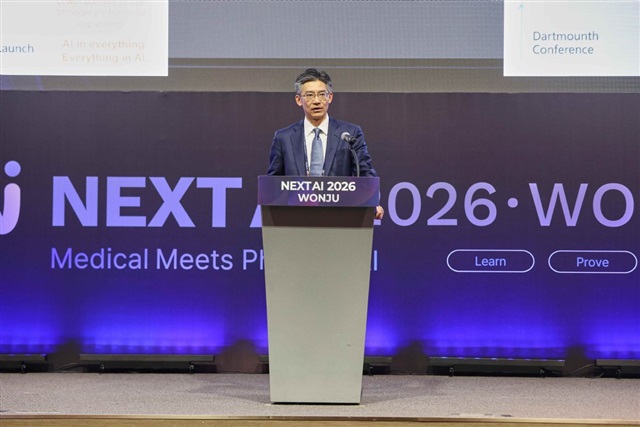
Xunfei Healthcare (iFLYTEK Medical), the healthcare AI arm of China's iFlytek, is using its Spark Medical Large Model to support diagnosis and medical record generation while tackling challenges including clinical workflow integration, differences in care settings, and model hallucinations. It also hopes to bring its experience from China to South Korea through local partnerships.
AI is clearly making an enormous impact on the global economy, with capabilities extending from language chatbots to agentic teams and the physical realm within just a few years. A new report by consulting firm Bain takes stock of AI's effects on businesses so far and projects how it could shape the near future.
Microsoft's in-house Azure Maia chips will become the main platform for its own AI services, including Microsoft 365 Copilot, GitHub Copilot and Microsoft Foundry. However, the company will keep using GPUs from Nvidia and AMD, Andrew Wall, general manager of the Azure Maia program, told DIGITIMES.
As the demand for green energy surges in parallel with order volumes and production capacity, scheduling for energy storage systems has become a critical technology to solve the problem of excess power for major tech firms, according to Kelsey Kuan, general manager of HD Renewable Energy subsidiary Star Trade. In an interview with DIGITIMES, Kuan also highlighted the rising technological barriers for electricity sellers, as the business now requires AI forecasting, transfer matching, energy storage, and integrated renewable-energy capabilities.
The European enterprise networking market has cleared its multi-year inventory digestion period. According to CONTEXT, sell-through via European distribution channels is growing in the low double digits entering 2026 across core infrastructure categories, including switches and enterprise wireless access points. That contrasts with the "heavy double-digit declines" the channel saw during COVID-19, said CONTEXT principal analyst Aaron Smith.
Singapore is building a semiconductor R&D hub by attracting both multinational investment and overseas research talent. Dr Yu-chieh Chien, a Taiwanese scientist at the Agency for Science, Technology and Research's Institute of Microelectronics (A*STAR IME), is one example.
The rapid iteration of AI-capable hardware, following an industry-wide push toward integrating AI-processing capabilities into PCs, is bringing renewed attention to what AI could offer as its presence extends further into the notebook market. But beneath the expanding promise of these machines lies a less straightforward question: what is actually compelling buyers to bring them into their businesses and homes?
GMI Cloud is making Taiwan a key part of its global AI infrastructure expansion, with a US$500 million investment in an AI factory powered by Nvidia's Blackwell GPUs. Announced in late 2025, the facility is expected to deploy roughly 7,000 GPUs and serve customers including Trend Micro and Wistron.
India's new semiconductor incentive regime is putting more capital at risk for manufacturers, but the first wave of investment commitments suggests lower subsidies have not stopped companies from considering fresh projects.
Advanced packaging remains one of the semiconductor industry's hottest technology areas in 2026. In Taiwan, terms such as co-packaged optics (CPO), chiplets, and glass substrates are increasingly common as packaging moves deeper into system-level design.
The global surge in AI demand is accelerating change across the semiconductor industry, and as Moore's Law scaling faces physical limits, chipmaking is no longer only about shrinking transistors. The industry is moving toward a "shrink and stack" model that combines continued scaling with increasingly complex 3D integration.
As artificial intelligence applications accelerate, surging global semiconductor demand is pushing advanced packaging, co-packaged optics (CPO), glass core substrates (GCS), and fan-out panel-level packaging (FOPLP) to the forefront of industry attention. Corning is expanding its footprint across the semiconductor supply chain by leveraging its core strengths in advanced glass formulations and optical fiber technologies, collaborating closely with value-chain partners to navigate next-generation technological shifts.
"He practically created a new era—the age of AI," Mou-Shiung Lin said of Nvidia CEO Jensen Huang. Yet, the early TSMC executive describes the methodology behind that success in blunt terms: it is "violent."
Advanced packaging is stretching semiconductor inspection in two directions at once: packages are getting larger while the features inside them are getting smaller.
Advanced packaging is reshaping the semiconductor value chain, making materials innovation a key source of technical breakthroughs. As large-format panel-level packaging (PLP) gains traction, Resonac CTO for semiconductor materials Hidenori Abe told DIGITIMES that the company sees five major materials challenges: warpage, plating, coating, bonding, and polishing.
WG Tech (Jiangxi) Group is accelerating its shift from display glass into semiconductor applications, targeting through-glass via (TGV) substrates for optical communications and advanced packaging as AI demand expands.