

Dixon Technologies is expanding into components, IT hardware, and new manufacturing categories as it seeks a place among the world's 10 largest electronics manufacturing services (EMS) companies within five years, making diversification central to its next growth phase.
Chairman and founder Sunil Vachani told Bloomberg Television in Mumbai that Dixon also aims to enter the global top five within a decade. The company currently sits outside the top 10, according to Bloomberg. Vachani outlined plans to increase margins through products such as camera modules while expanding smartphone and laptop production.
"We need to be in the top ten EMS global rankings in the next five years and the top five in the next 10 years," he said.
Building beyond handset assembly
The strategy combines expansion into new product categories with manufacturing more of the components inside those products. Bloomberg reported that Dixon is pursuing server and defense manufacturing, partnering with a Taiwanese company on optical equipment for data centers, and preparing to open a second IT hardware plant in late November.
Vachani put India's annual IT hardware imports at almost US$15 billion, describing import substitution as a major growth opportunity. That figure is his estimate of the market opportunity, rather than Dixon's projected revenue.
Management's July 31 earnings call outlined how the expansion could develop. Dixon's partnership with Inventec covers IT hardware, with discussions extending to enterprise servers and data center equipment. The company also planned SSD production and identified power supplies and mechanical components as possible areas for further integration. Its Gemtek venture targets optical transceivers for telecom networks and data centers.
These projects are at different stages. On the call, executives described server expansion as an opportunity under discussion. The Bloomberg interview also identified defense as a direction for expansion, but no order book or revenue target was disclosed.
Components and design widen the offering
Dixon is expanding camera-module capacity and preparing display-module production for phones, IT equipment, and automotive applications. Management said these investments would increase domestic value addition and support margins as production scales.
Dixon's original design manufacturing (ODM) ambitions extend beyond electronics components. The earnings call described plans for dishwashers, front-loading washing machines, and a broader refrigerator portfolio, alongside a shift toward ODM in premium televisions. These initiatives would expand the company's role in product development and manufacturing.
Phone assembly remains part of the growth plan. Bloomberg reported that the company secured government approval for a venture with Vivo's Indian unit, while management said in July that it expected the venture to begin contributing revenue in the third quarter of fiscal 2027.
Revenue concentration remains high
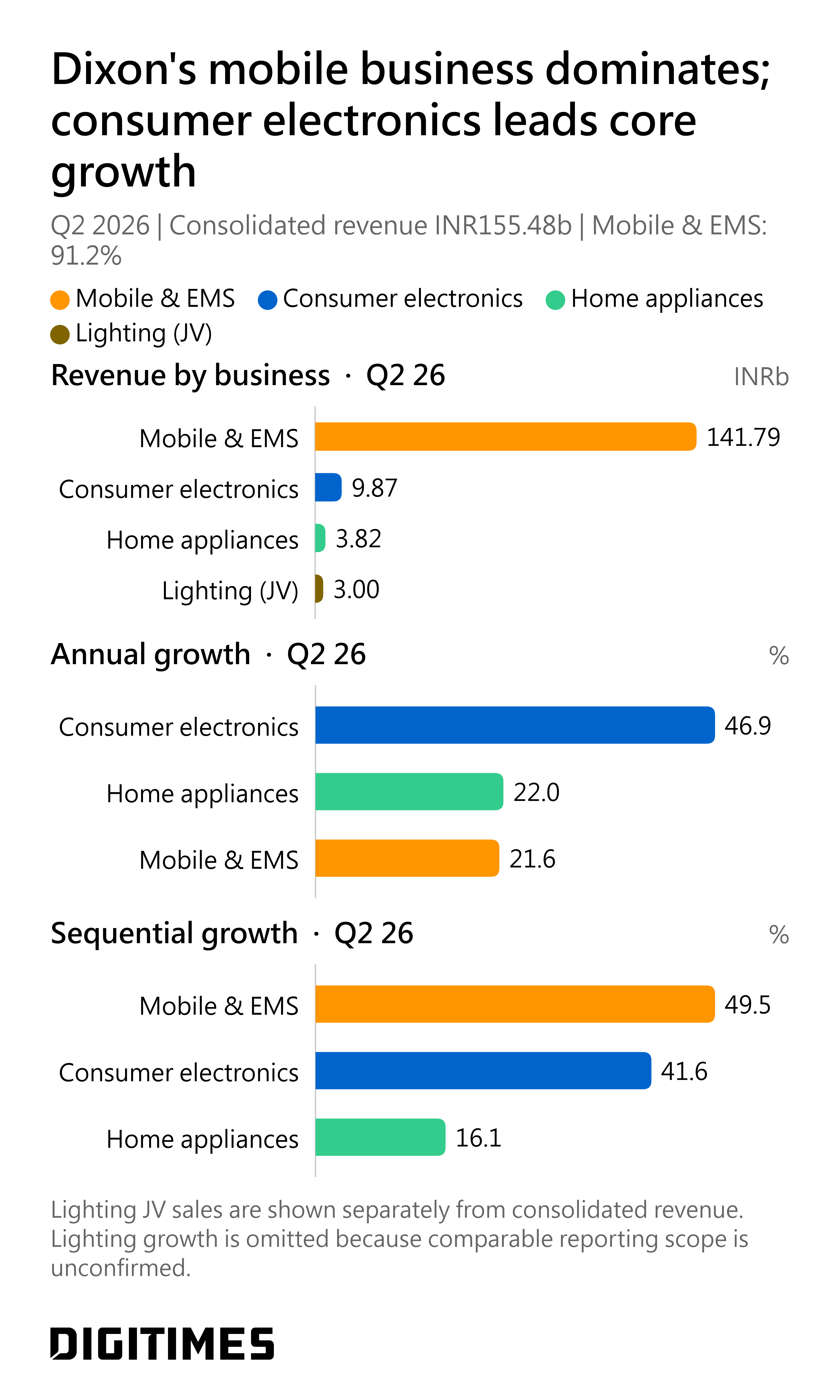
The financial data shows how much diversification is still needed. The firm's mobile and other EMS revenue stood at INR141.79 billion (US$1.48 billion) in the quarter ended June 30, 2026, accounting for about 91.2% of consolidated sales. That category includes activities beyond smartphones and should not be read as handset revenue alone.
Consumer electronics generated INR9.87 billion, up 46.9% year over year, while home appliances rose 22.0% to INR3.82 billion. Both segments grew but remained much smaller than mobile and other EMS, whose revenue increased 21.6%. These figures show growth outside the dominant division, though that division's broad reporting category limits visibility into the individual contributions of newer businesses.
The push comes as handset demand weakens. Omdia estimated that Indian smartphone shipments fell 13% to 33.9 million units in the second quarter of 2026. Principal analyst Sanyam Chaurasia said vendors were simplifying portfolios and managing inventory more selectively as rising prices constrained affordability.
Higher sales, thinner margins
Consolidated quarterly revenue increased 21.1% to INR155.48 billion, but Bloomberg financial data shows operating margin falling to 2.29% from 3.04% a year earlier.
Financial Express reported that net profit attributable to owners reached INR6.63 billion, boosted by a fair-value gain on Dixon's Aditya Infotech stake. Excluding that gain, adjusted profit attributable to owners fell 3% to INR2.18 billion. Management attributed margin pressure to the expiry of the first mobile production-linked incentive scheme and higher component costs, which lifted selling prices through contractual pass-through arrangements.
Management expects component integration to help restore margins from fiscal 2028. That leaves Dixon's top-10 ambition dependent on a transition still taking shape: expanding new businesses, increasing component production, and converting a broader manufacturing portfolio into sustained earnings growth.
Credit: Compiled by DIGITIMES
Article edited by Jerry Chen