

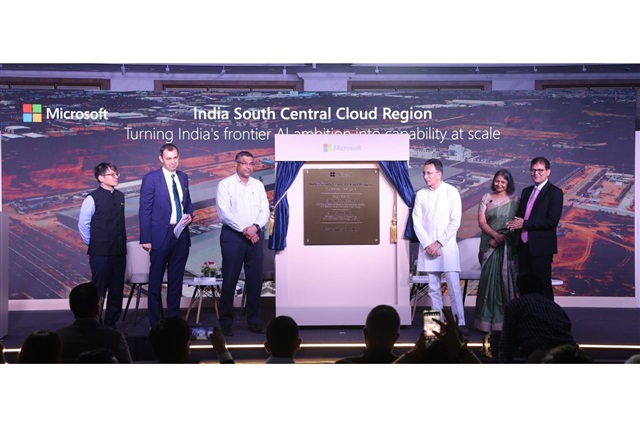
Microsoft has turned a headline slice of its US$20.5 billion India commitment into operating infrastructure, opening a Hyderabad cloud region it intends to serve customers well beyond India's borders. The move positions the country as a supply base for AI compute at a moment when it generates far more data than it can process at home.
Credit: DIGITIMES
A capacity gap pitched as the opportunity
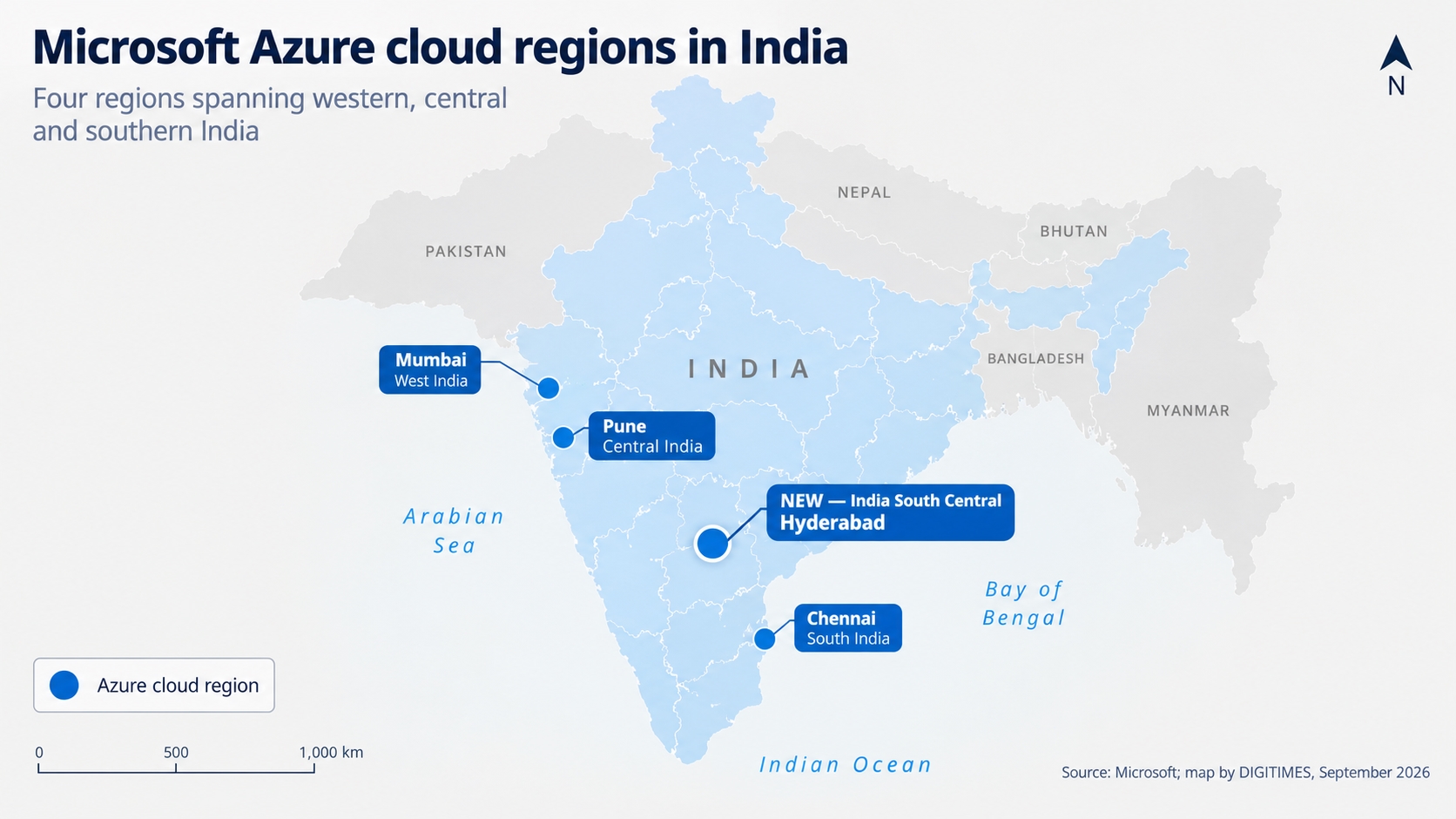
Speaking at the company's AI Infrastructure Summit in New Delhi on 21 September, Puneet Chandok, president, Microsoft India and South Asia, said India South Central — the company's fourth cloud region after Pune, Chennai, and Mumbai — is live and designated "a strategic hub for Asia and the Global South." Microsoft also said every one of its India data center regions is now AI-enabled, built with AI-capable hardware and high-efficiency cooling.
"India is generating 20% of the world's data, but only 3% of the world's data center capacity sits in our country," Chandok said, according to Moneycontrol. "Between these two numbers sits the largest opportunity of the decade for India." He put India's current capacity at roughly 2GW, rising to 12-14GW by 2035, and told the Economic Times that "demand is not the issue. We need to get the supply," citing 40% of Indian enterprises now scaling AI use beyond pilots.
Those figures sit at the optimistic end of a range. Livemint reports government data putting current capacity at 1.5GW, with Wood Mackenzie forecasting 12GW as early as 2030 — a faster ramp than Chandok's 2035 horizon.
What the region actually carries
India South Central launches with a broad Azure portfolio and a three-zone architecture, with the full Azure and AI line-up, including Microsoft Foundry, arriving over the coming months. Microsoft said Adani Group, Bajaj Finserv, HDFC Bank, and PB Pay have already signed on. The site runs on high-efficiency mechanical cooling that the company says uses effectively zero water.
The region also anchors Microsoft's sovereign cloud pitch: data residency options and governance capabilities aligned with MeitY guidelines and India's Digital Personal Data Protection framework, plus sector guidance from the RBI and CERT-In. Microsoft frames these as capabilities that help customers address requirements, not as guarantees of compliance.
A crowded and better-funded field
Microsoft's US$20.5 billion is no longer the largest bet on Indian AI infrastructure. Amazon said in June it would raise its India total to US$48 billion between 2026 and 2030, CNBC reported, while Google committed roughly US$15 billion through 2030 to an AI hub in Visakhapatnam, according to TechCrunch. Microsoft's own top-up — US$17.5 billion over 2026-29 — was announced in December 2025.
Cheap power, harder constraints
What draws them is cost. Building a data center in India runs US$6-7 million per MW against US$10-14 million in the US and Europe, per a Nomura report cited by Livemint, with Chennai power at about 8.4 US cents per kWh versus Singapore's 18.1. Naresh Singh, senior director analyst at Gartner, told Livemint that India's plans to draw a significant share of data center energy from renewables "make it a viable destination for large-scale gigawatt data centers."
The bottlenecks are land, grid, and water. Microsoft's answer to the last is the zero-water cooling claim and a groundwater-recharge program at Elikatta near Hyderabad, which it says added about 5 million liters of recharge capacity by June 2026. A BCG study cited by Microsoft estimates India's data center buildout could generate US$140-200 billion in economic output through 2030.
Article edited by Jerry Chen