

Aircraft and spacecraft may be judged by thrust, payload capacity, and range, but the German Industry Solutions Session held at Automation Taipei 2026 on August 20 suggested that some of aerospace manufacturing's most consequential advances are taking place somewhere far less visible: inside connectors, bonded joints, laser-processed surfaces, dispensing paths, and robotic assembly cells.
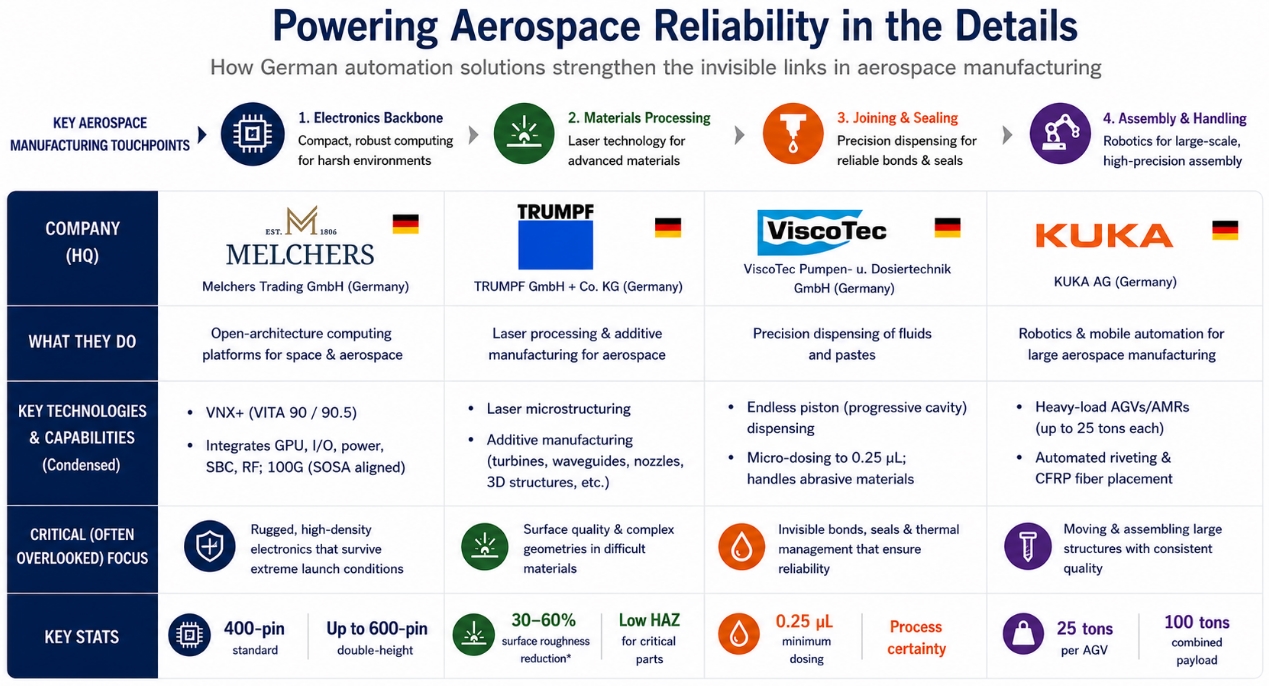
Source: data compiled from Automation Taipei 2026 (German Industry Solutions Session ll); chart compiled by DIGITIMES
Across presentations from Melchers Trading, TRUMPF Taiwan, ViscoTec, and KUKA Automation Taiwan, a common theme emerged. As aerospace systems become lighter, more compact, and more complex, manufacturing reliability increasingly depends on technologies capable of removing variability from the smallest—and often overlooked—parts of the production chain.
Compressing space electronics without compromising reliability
Vinent Huang, project manager at Melchers Trading's Taiwan branch, focused on VNX+, an open-architecture platform defined under VITA 90 specifications for compact embedded computing.
The concept is designed to integrate GPUs, I/O, power supplies, single-board computers, and even RF components into a tightly packed system suitable for space deployment. Standardized interfaces allow hardware from different vendors to be mixed and matched, while high-density connectors can carry 400 pins, with double-height configurations reaching 600.
For launch environments, however, density alone is not enough. Huang emphasized that vibration, temperature response, weight, and power consumption all become critical design constraints.
"In principle, the smaller, lighter, and more power-efficient a device is, the better the solution," he said.
The platform also sits within the Sensor Open Systems Architecture (SOSA) framework, where Huang highlighted 100G protocol support and integrated RF/optical connectivity. This reflects a broader move toward standardized, interoperable electronics that can survive harsh aerospace environments without requiring fully proprietary architectures.
Lasers move deeper into aerospace materials processing
TRUMPF Taiwan managing director Patrick Kemnitz and sales manager Chris Huang shifted the discussion from electronics to materials.
Their presentation showed lasers moving beyond conventional cutting and welding into applications including aircraft-wing microstructuring, turbine-blade manufacturing, satellite payload systems, waveguides, and rocket ignition nozzles.
Highly reflective copper remains difficult to process with conventional laser wavelengths, but TRUMPF said green lasers and other specialized wavelengths can address copper alloys used in thermal and electronic systems. Laser additive manufacturing can also create complex geometries, including fine nozzle holes and redesigned waveguide structures.
The company further highlighted reduced heat-affected zones and said laser-based processing can improve surface roughness by around 30% to 60% across aerospace materials including Ti-6Al-4V and aluminum 2024.
Reliability increasingly depends on the joint
Markus Schultz, CEO of ViscoTec Greater China, turned attention toward an even less visible part of aircraft assembly: the fluids holding structures together.
"As aircraft structures grow lighter and composite materials are getting a larger share, are traditional labor-intensive mechanical fasteners or gaskets still sufficient… or are we reaching the limits of reliability?" Schultz asked.
ViscoTec's progressive-cavity-based "endless piston" technology is designed to dispense abrasive or shear-sensitive materials at low pressure with high repeatability. Aerospace applications include fuel-tank sealants, honeycomb potting, sandwich-panel insert bonding, thermal pastes, avionics potting, and structural adhesives. Its smallest dispenser can dose volumes down to 0.25 microliters.
Schultz framed the value less as a pumping technology than as manufacturing control.
"ViscoTec does not only provide a pump—it provides process certainty," he said.
Robotics scales from rivets to entire wings
KUKA Automation Taiwan closed the session by expanding automation from microscopic joints to aircraft-scale handling.
Jean Huang, the company's marketing and PR manager, cited German aerospace applications in which four 25-ton automated guided vehicles can be linked to transport loads of up to 100 tons, including large aircraft wings. KUKA systems are also used for automated riveting and, with the German Aerospace Center, for automated fiber placement of carbon-fiber-reinforced plastics.
Huang noted that an aircraft can contain around 60,000 fasteners or rivets, making consistency itself a manufacturing challenge.
Taken together, the presentations suggested that the future of aerospace automation may be defined less by one breakthrough metric than by thousands of tightly controlled processes—from signal connectors and laser-treated surfaces to adhesive joints and robotic fastening.
The technologies may be easy to overlook. Their failure, however, would be impossible to ignore.
Article edited by Ysi Chen