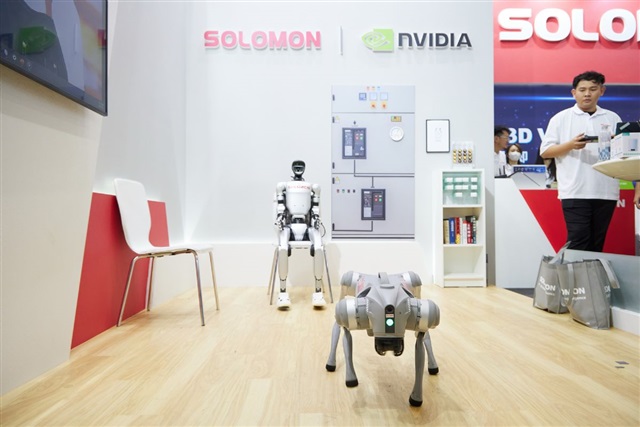
The humanoid robot market is opening new AI supply-chain opportunities for Taiwanese manufacturers, while lifting broader robotics demand worldwide. Yet industry players say large-scale deployment remains distant, as companies focus on practical machines for specific jobs and wait for humanoid systems to become more reliable, affordable, and adaptable.
Perception is still the bigger bottleneck
People familiar with the sector said humanoid robots still face two core challenges: understanding their surroundings and carrying out tasks. On the perception side, robots learn too slowly because real-world physical data is scarce, and high-quality data is even harder to obtain. Simulation data can reduce costs, but it still differs from real-world conditions, limiting transfer between virtual and physical environments. That gap leaves robots weak in cross-scenario and cross-task use, as well as in generalization, making it difficult for them to handle the variability and complexity of real-world settings, which industry players called one of the biggest bottlenecks blocking wider adoption.
Sensing and coordination still need to catch up
Sensing is the first point of contact between robots and the outside world, and multimodal perception fusion is still immature. Robots must control multiple joint motors simultaneously, while synchronizing with imaging systems in real time. That requires tight coordination among components, as well as careful processing and release of control signals. Industry observers said true progress depends on whether all subsystems can be integrated into a machine that is both movable and usable.
The "nearsightedness" problem in robot vision
Vision is especially important. Research institutions say visual systems account for about 40% of a robot's overall sensing system, making them the most widely used and critical perception channel in smart robots. Even so, many humanoid robots still suffer from what industry players call severe nearsightedness, with recognition accuracy and detail falling sharply beyond one meter.
That means robots need better environment-search capabilities, including repositioning, changing viewing angles, and using optical data and software to identify targets. Even when a robot recognizes an object, converting that result into accurate spatial coordinates remains another major challenge.
Precision hands, the operation-side challenge
On the operation side, the main hurdles are end-effector precision, flexibility, and accuracy in human-machine interaction. Dexterous hands must balance lightweight design, high load capacity, and high precision, but those goals often conflict. Different technical approaches offer trade-offs between freedom of movement, accuracy, and cost.
Scenario-specific machines, not humanoid looks, drive scaling
Manufacturers said the real key to scaling smart robots is meeting specific scenario demands, not humanoid appearance. Rather than chasing general-purpose robots, many believe resources should go into functional machines for tasks such as transport and picking, while technology and data continue to accumulate.
Article translated by Jingyue Hsiao and edited by Jerry Chen