
AI's rapid evolution — from AI servers to agentic AI and emerging physical AI — centers on high-performance computing, and integrating general fault-tolerant quantum computers into that stack could change what HPC can do. The transition, however, confronts deep technical mismatches between classical AI servers and quantum processors.
AI servers today hinge on classical CPUs, GPUs optimized for tensor operations, and HBM, while quantum computers rely on superposition and entanglement. Although quantum theory subsumes classical mechanics in principle, the practical hardware architectures for each operate at very different physical extremes, creating significant integration challenges.
Nvidia has begun software preparations with CUDA-Q, treating quantum processing units as accelerators and supporting multiple qubit technologies, but software compatibility alone does not resolve the hardware-level gaps. Latency, signal types, and cryogenic constraints give rise to divergent system architectures, complicating the creation of effective hybrid workflows.
Signal, latency, and temperature constraints
A central issue is timing. AI chips exhibit nanosecond-scale component latencies, while overall system delays can reach microseconds or milliseconds. Quantum computations depend on qubit coherence times — the duration for which entanglement persists —, and if classical round-trip latency exceeds coherence, hybrid routines such as the variational quantum eigensolver and quantum approximate optimization algorithm cannot close the feedback loop needed for iterative optimization. This latency problem is particularly acute for superconducting qubits, which currently dominate commercial development and have shorter coherence windows.
Nvidia's investment choices highlight alternatives: PsiQuantum (photonic qubits), Quantinuum (trapped ions), and QuEra (neutral atoms) use qubit modalities with coherence times substantially longer than typical AI server latencies, potentially sidestepping the coherence mismatch. Signal representation also differs: AI systems process digital tensor data at high bandwidth, while quantum information is carried by qubits and often controlled by analog microwave signals. Converting digital inputs into quantum amplitude or phase encodings consumes many quantum gates, adding overhead that can negate theoretical benefits.
Signal fidelity and system architecture
The architectures have been optimized around distinct signal behaviors. AI workloads emphasize asynchronous, batch-oriented throughput, whereas quantum processors require deterministic, low-payload control signals at high repetition rates. Integrating both demands new interconnect and control approaches capable of handling frequent digital-to-analog and analog-to-digital conversions without undermining performance.
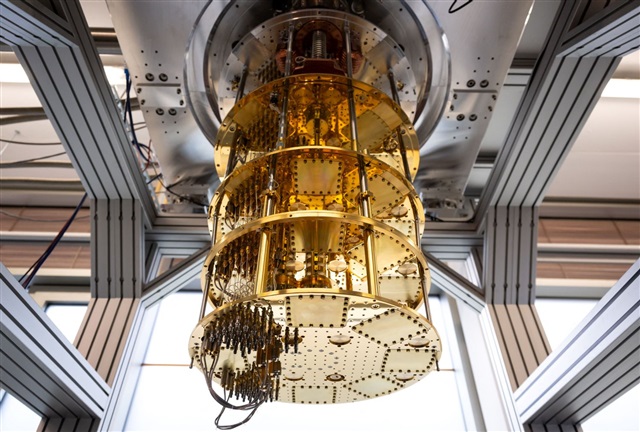
Thermal environments create another stark contrast. Some qubit technologies need dilution refrigerators operating at 10–20 millikelvin, while AI servers manage heat dissipation with liquid cooling at much higher temperatures — a gap spanning as much as seven orders of magnitude. Yet not all qubit types need extreme cryogenics: trapped ions and photonic qubits can operate at or near room temperature, reducing one axis of incompatibility.
Why photonic qubits are attractive for HQCC
Photonic qubits present several integration advantages. Photons do not suffer significant decoherence, unlike other qubit types, eliminating the latency-driven coherence constraint in many settings. Though challenges remain — photon loss in waveguides and the low probability of nonlinear interactions — photonic systems avoid electromagnetic interference issues and are less affected by AI server heat dissipation. Current photonic setups may still use cryogenic superconducting nanowire single-photon detectors at one to four kelvin to boost detection probability, though the photonic qubits themselves can remain at room temperature.
Industry factors also favor photons. Photonic QPU fabrication is compatible with semiconductor processes, lowering commercial scaling barriers and supporting ambitious expansion targets such as million-qubit devices. Concurrently, AI infrastructures are moving toward all-optical components to reduce energy and thermal costs, a trend that dovetails with optical quantum interconnects and could simplify hybrid integration.
Practical outlook
Other integration hurdles remain, including electromagnetic interference, physical-layer engineering, and bridging differences in data-rate behavior. Edge AI techniques may mitigate some problems by locating classical processing closer to quantum nodes, reducing latency and data-transfer burdens. Though nations treat quantum computing as a strategic priority and are funding research accordingly, investment in quantum remains small compared with the global capital poured into AI. Pursuing quantum modalities that most naturally complement AI-server architectures — particularly photonic approaches — may therefore allow hybrid quantum-classical computing to leverage the momentum and funding of today's AI ecosystem.
Article translated by Jingyue Hsiao and edited by Jerry Chen