

CONNECT WITH US
Sign out

Taiwan accelerates SiPh and materials breakthroughs for next-gen AI computing

, Taipei
0

Credit: DIGITIMES

Taiwan is stepping up its global semiconductor leadership with a coordinated push into silicon photonics (SiPh) and advanced materials, aiming to meet surging demand for faster, more energy-efficient AI computing while strengthening domestic technological autonomy.

To implement its "10 major AI infrastructure projects" policy, Taiwan's Ministry of Economic Affairs (MOEA) and National Science and Technology Council (NSTC) have jointly launched an ambitious initiative to accelerate SiPh development and build a self-reliant industry ecosystem. The program reflects mounting global demand for high-speed data processing and low-power communication, both critical to scaling artificial intelligence and data center performance.

Building autonomy in silicon photonics

SiPh has emerged as a cornerstone technology for next-generation computing, enabling faster data transmission using light instead of electrical signals. Rather than relying on licensed solutions from abroad, Taiwan's universities and research institutions are prioritizing end-to-end technological autonomy, spanning materials development, fabrication equipment, and system integration. Achieving this goal requires sustained investment in forward-looking SiPh research, alongside the establishment of robust co-packaging, testing, and verification platforms to support scalable, high-performance applications.

Backed by NSTC funding, Taiwan's SiPh R&D is targeting key performance priorities, including ultra-high data transmission speeds, low power consumption, and heterogeneous integration. These efforts focus on developing next-generation optical interconnect modules while advancing high-speed optical switching technologies to shorten data transfer paths. By reducing latency and improving energy efficiency, these innovations are set to deliver more stable, efficient data exchange, positioning Taiwan at the forefront of next-generation computing infrastructure.

Expanding into optical sensing and computing

Beyond optical communications, the initiative is expanding SiPh applications into optical sensing and optical computing. These emerging fields hold promise for breakthroughs in areas ranging from environmental monitoring to AI acceleration.

Equally important is the development of cross-disciplinary talent. The program integrates expertise in optoelectronics, IC design, semiconductor packaging, and system-level engineering. By encouraging researchers to think beyond individual components and toward full system architectures, Taiwan is cultivating a workforce capable of driving innovation across the entire semiconductor value chain.

Breakthroughs in memory and advanced materials

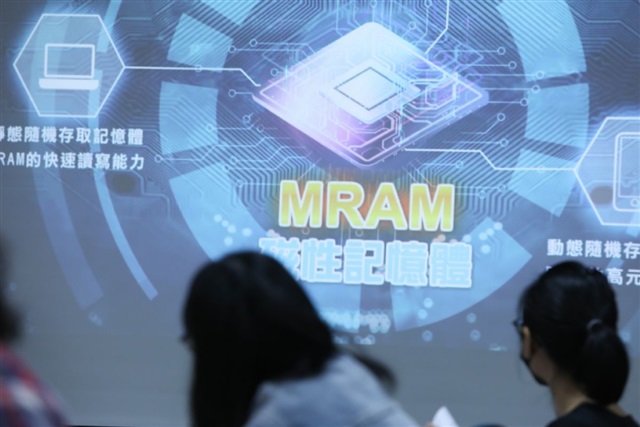
In natural science research, the NSTC emphasizes that breakthroughs in fundamental materials can be translated into core technologies that power future industries. For example, a team at National Yang Ming Chiao Tung University (NYCU) has advanced spin-orbit torque magnetic random-access memory (SOT-MRAM) by overcoming key material limitations through innovative tungsten thin-film designs. Their approach enhances material phase stability, overcoming a longstanding bottleneck in which existing memory technologies struggle to deliver both ultra-fast switching speeds and long-term reliability.

The NYCU team successfully demonstrated a 64-kilobit SOT-MRAM array integrated with CMOS control circuits, achieving write speeds as fast as one nanosecond and data retention exceeding 10 years. This breakthrough could play a crucial role in enabling low-power computing for large language models (LLMS) and automotive electronics, where speed and durability are both essential.

Additionally, researchers at NYCU have unraveled the complex relationship between crystal structure and electronic behavior, offering deeper insights into bias-induced material transition mechanisms. These findings are expected to support the design of next-generation charge density wave (CDW) devices and enhance their reliability in practical applications.

Further advances are emerging from National Cheng Kung University, where researchers have leveraged ion beam systems and high-resolution transmission electron microscopy to analyze high-K ferroelectric materials. They successfully developed the world's first suspended ferroelectric two-dimensional transistor.

Article translated by Willis Ke and edited by Jack Wu