

Quantum computing is shifting from isolated experiments toward hybrid architectures integrated with high-performance computing and artificial intelligence (AI), speakers said on March 25 at the AI Expo Taiwan 2026, as the industry looks to position quantum systems as components within data center infrastructure rather than standalone research platforms.
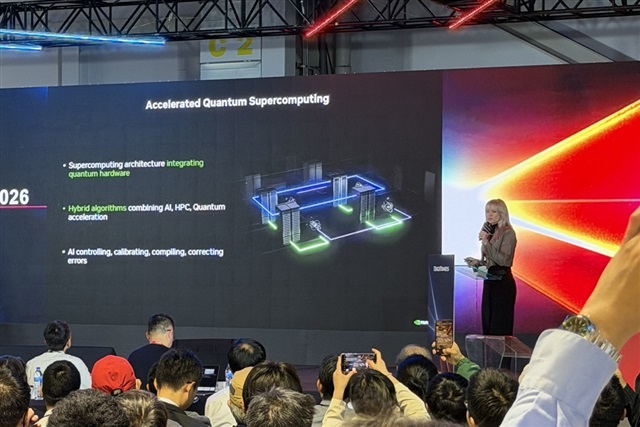
Linsey Rodenbach, Nvidia's quantum computing developer relations manager, described the emerging approach as an "accelerated quantum supercomputer" architecture, in which quantum processors function as scientific instruments that complement existing computing systems.
Under this model, quantum hardware would be deployed alongside GPUs within data centers and connected through high-bandwidth, low-latency interconnects such as NVQ-Link. The configuration allows AI, high-performance computing, and quantum workloads to run in tandem, reducing reliance on remote cloud access and enabling quantum-generated data to be fed directly into AI pipelines.
Credit: Sherri Wang
2028 seen as key transition point
The industry remains in the physical qubit stage but is approaching a potential transition, said Ching-Ray Chang, director of the Quantum Information Center at Chung Yuan Christian University.
Industry roadmaps, including those from IBM, suggest quantum systems could exceed 100 logical qubits by 2028, a level often cited as a threshold for performing selected tasks beyond classical computing.
Chang said quantum entanglement could also enhance AI optimization by helping models avoid local minima, potentially improving efficiency and reducing energy consumption.
Security concerns drive early cryptography shift
Advances in quantum computing are also raising concerns over future cybersecurity risks.
Yeh Ping, a software engineering manager at Google Quantum AI, said large-scale quantum systems capable of breaking RSA encryption are not expected until around 2035, but warned that "store now, decrypt later" attacks already pose a risk, as encrypted data collected today could be decrypted once more advanced quantum hardware becomes available.
Given the time required to transition to post-quantum cryptography, Yeh said enterprises and governments should begin migration efforts well ahead of that timeline, potentially by 2030.
Supply chain and talent gaps remain
Speakers said the shift toward hybrid architectures could create opportunities for Taiwan's semiconductor sector, particularly in component manufacturing and system integration, though gaps remain across the supply chain.
These include limited hardware specialization and a shortage of cross-disciplinary expertise. Rather than requiring deep expertise in quantum physics, the industry is expected to prioritize "quantum literacy," with engineers able to work across software and hardware layers.
Tools such as Nvidia's CUDA-Q are helping lower barriers to entry by enabling developers to work within hybrid quantum-classical environments.
While large-scale commercial deployment remains years away, quantum computing is increasingly being positioned as a complementary layer to AI infrastructure, particularly in areas such as data generation and optimization.
Article edited by Jack Wu