
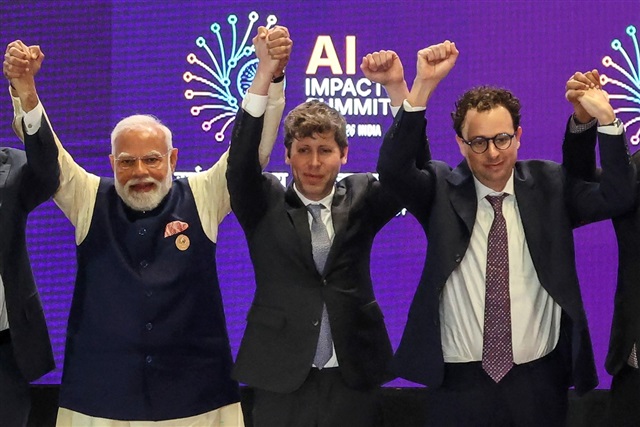
At the India AI Impact Summit 2026, global tech executives and policymakers highlighted AI's transformative potential, warning that uneven adoption risks widening global disparities. Speakers emphasized infrastructure, skills, and governance as crucial for ensuring AI drives inclusive growth and innovation worldwide.
At the India AI Impact Summit 2026, held from February 16 to 20 at Bharat Mandapam in New Delhi, several global technology leaders underscored the urgency of responsibly and inclusively expanding AI, highlighting the potential for AI to reshape economies and societies worldwide.
Microsoft's Vice Chair and President, Bradford L. Smith, described the gathering as an opportunity to collaborate on bringing AI to the Global South, emphasizing that the discussions focused on creating pathways for broader adoption rather than on commercial gain. Smith framed AI as a tool for economic empowerment, noting the importance of building digital capacity, skills, and inclusive ecosystems across regions that historically have been underrepresented in AI development.
Alexandr Wang, Chief AI Officer at Meta, highlighted India as a positive case study, citing the country's deep talent pool and the rapid growth of consumer AI startups, which he noted now outnumber those in the US. Wang suggested that the current period marks the beginning of a genuine acceleration in technology and underscored the importance of supporting global talent networks and local innovation.
Similarly, Shantanu Narayen, Chair and CEO of Adobe, discussed how AI could expand opportunities for creativity, particularly among students, and emphasized India's potential to lead in data governance, privacy, and security.
Global policy and advisory perspectives were also prominent. George Osborne, heading OpenAI's "for countries" programme and former UK Chancellor, warned nations against lagging in AI adoption, stressing that countries that fail to embrace AI risk becoming weaker and poorer.
Janet Zhou of the Gates Foundation echoed this sentiment, emphasizing that the principal challenge lies not in invention but in real-world adoption, and advocating for shared infrastructure and AI applications targeted at pressing social and economic problems. Robert Opp, Chief Digital Officer at UNDP, reinforced the need for foundational digital public infrastructure and robust data governance, noting that many countries' ambitions exceed their current capacity to implement AI at scale.
Voices from technology entrepreneurs and AI practitioners stressed practical and ethical considerations. Chris Lehane of OpenAI emphasized a balanced approach, describing the company's optimism tempered with realistic safety measures before AI release, and called for societal mechanisms to build resilience.
Raffi Krikorian, CTO at Mozilla, highlighted the importance of digital sovereignty at every level, arguing that governance frameworks must protect users and communities, not just national interests.
Jay Puri, executive vice president at Nvidia, illustrated the shift from traditional programming to intent-based AI systems, in which machines can understand context and reason rather than follow rigid instructions, demonstrating the expanding potential of AI across professional and everyday applications.
Other leaders stressed AI's role in reducing repetitive work and amplifying human productivity. Arvind Jain, founder and CEO of Glean, described AI as a tool that relieves people of monotonous tasks, freeing them to engage in creative work.
Stuart Russell, a leading AI researcher at UC Berkeley, issued a cautionary note on safety, warning about manipulative AI systems and the potential harm to vulnerable populations, including children. These concerns highlighted a shared understanding among global entrepreneurs and technologists that AI's transformative potential must be carefully managed to ensure societal benefit while mitigating risk.
Throughout the summit, the recurring theme was that AI's impact will be determined by the combination of infrastructure, skills, governance, and ethical design, and that meaningful international cooperation is essential. The perspectives offered by these global leaders reinforced a vision of AI as both a driver of innovation and a responsibility, particularly in ensuring equitable access and shaping the technology to serve communities worldwide.
Article edited by Jingyue Hsiao