

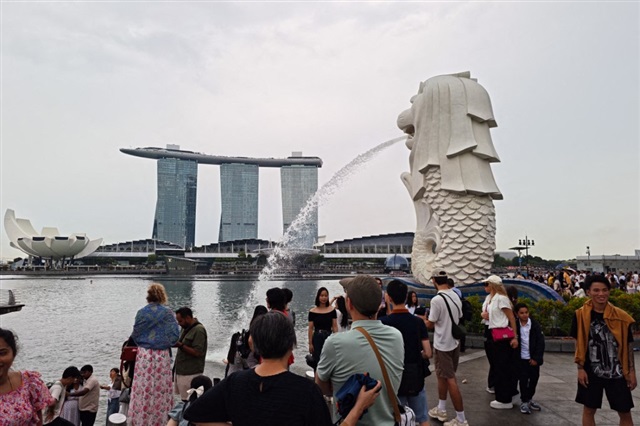
Singapore has committed S$1 billion (US$786 million) to fund public artificial-intelligence research over the next five years, signalling a more assertive state role as global competition over AI capabilities intensifies.
The funding forms part of the National AI Research and Development Plan, unveiled by Josephine Teo, Singapore's minister for digital development and information, at the Singapore AI Research Week 2026 gala dinner on Saturday, according the Bloomberg news.
The programme will run from 2025 to 2030 and is intended to strengthen the country's domestic research base while reinforcing its position as a global hub for AI development.
Ms Teo said the initiative reflects Singapore's belief that research, rather than adoption alone, will determine long-term competitiveness in artificial intelligence.
In a statement accompanying the announcement, the Ministry of Digital Development and Information said research would serve as the central driver of the country's AI strategy, enabling Singapore to build deep technical capabilities and reduce reliance on external technologies.
The government is betting that a substantial and sustained injection of public funding can help a small, open economy remain relevant in a field dominated by large firms and research institutions in the United States and China. The investment will support the establishment of new AI research centres, expand national computing and research capabilities, and strengthen the local talent pipeline.
The plan sits within the framework of Singapore's updated National AI Strategy 2.0, which marked a shift from applied pilot projects toward a more structural approach. The original strategy, launched in 2019, focused on deploying AI in priority sectors such as healthcare, logistics and education.
The revised version, announced in 2023 by then deputy prime minister Lawrence Wong, set a more ambitious objective: to more than triple the number of AI practitioners to 15,000 and position Singapore as a global meeting point for leading AI researchers and builders.
Singapore's move reflects a broader global trend toward what policymakers increasingly describe as "sovereign AI". Governments are seeking greater control over talent, data and foundational technologies as AI becomes central to economic growth and national security. From East Asia to the Middle East, public funding is being deployed to ensure domestic capabilities are not eclipsed by foreign platforms.
The S$1 billion AI research commitment will be drawn from a larger S$37 billion research, innovation and enterprise funding pool managed by the National Research Foundation, announced in December 2025. The foundation has said the broader allocation is intended to address long-term national priorities, including talent development and the use of AI as a transformative force across the economy over the next five years.
For Singapore, the strategy is a calculated one. As artificial intelligence shifts from a commercial tool to a strategic asset, remaining competitive may depend less on speed and flexibility, and more on the willingness of the state to invest at scale and for the long term.
Article edited by Joseph Chen
