


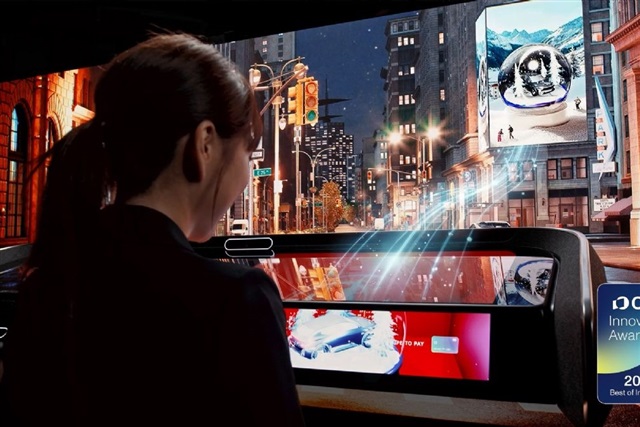
LG Display president Jeong Chul-dong has pledged to make transparent OLED a core growth priority in 2026, aiming to lift panel transparency from 45% to 70% as the company targets XR devices and next-generation automotive displays.
According to Businesspost, LG Display has already pushed transparent OLED transmittance to about 45%, with industry sources suggesting research and development-stage panels may be approaching 50%. Jeong has set a short-term target of 70% transparency, a threshold widely seen as viable for automotive windshields.
Jeong has positioned transparent OLED as a mid-to-long-term growth engine, signaling a strategic bet on OLED as LG Display's future revenue backbone through sustained leadership in next-generation display technologies.
Strategic restructuring
Since taking the helm in 2025, Jeong has overhauled LG Display's business portfolio to stem losses and refocus on OLED. Key moves include the sale of the Guangzhou plant in China and a KRW700 billion (US$483 million) infrastructure investment approved in June 2025 to develop new OLED technologies in Paju.
Technical leadership drives innovation
Development of transparent OLED is expected to be led by CTO Choi Young-seok, who was promoted to executive vice president in LG Display's year-end 2025 personnel reshuffle. Widely regarded as an engineer-driven executive, Choi is known for process innovation and yield stabilization. According to Youth Daily, LG Display's Consumer Electronics Show (CES) 2026 strategy will also spotlight OLED panels reaching up to 4,500 nits, supporting XR and mobility use cases.
Unique market position
LG Display is currently the only company to have commercialized transparent OLED at scale. Rivals such as Samsung Display (SDC) and BOE are developing transparent displays using LCD or Micro LED, but remain behind in both mass production readiness and transmittance performance. Mordor Intelligence estimates the global transparent display market will expand from KRW6.4 trillion (US$21 billion) in 2025 to KRW32.8 trillion by 2030, representing a compound annual growth rate of 38.6%.
Shifting demand dynamics
Historically, demand for transparent displays was largely limited to business-to-business digital signage, including premium retail and museum installations. That is now changing, as AR wearable adoption accelerates and software-defined vehicles (SDV) gain traction, setting the stage for broader, higher-volume applications.
CES 2026 showcase
At CES 2026 in Las Vegas, LG Electronics plans to unveil an AI-based automotive display solution that integrates transparent OLED panels into vehicle windshields, enabling real-time navigation and road data to be overlaid directly in the driver's line of sight, according to Etoday.co.kr.
The push highlights transparent OLED's appeal as a natural interface for future mobility, where safety, situational awareness, and seamless content overlay are becoming non-negotiable as AR hardware and in-vehicle intelligence converge.
Article edited by Jerry Chen