CONNECT WITH US
Sign out

From ground to sky: How Taiwan's Tmytek is shaping future of seamless connectivity

Chong Jing, Taipei
0

Credit: AFP

As governments and businesses worldwide demand greater communications resilience, relying solely on terrestrial mobile networks and fixed-line infrastructure no longer suffices.

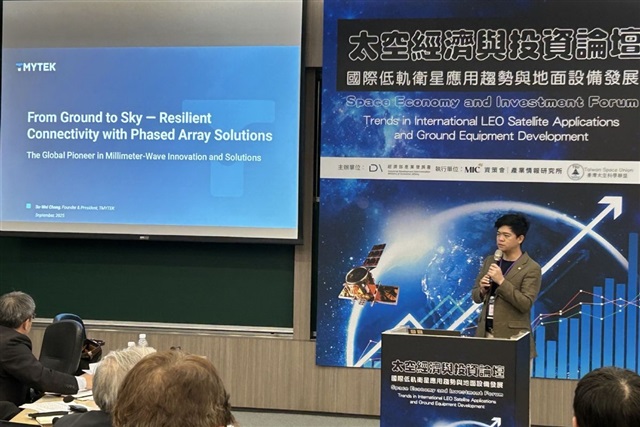
At the Space Economy and Investment Forum on September 24, Su‑Wei Chang, President of Tmytek, laid out a vision for building a seamless "ground‑to‑sky" network architecture. He identified three emerging industry trends: the integration of multiple orbital layers (Multi‑Orbit), the strategic rise of high‑altitude platforms (HAPS), and the accelerating standardization of non-terrestrial networks (NTN).

Goodbye to single-layer systems

Chang observed that enterprise, government, and defense users increasingly expect uninterrupted, resilient connectivity, and that demand is pushing network operators toward supplying services across multiple orbits and toward alternative infrastructure like HAPS.

He noted that many satellite operators previously used proprietary systems, but to satisfy more stringent resilience requirements, consolidation and cooperation between operators have grown. Today, firms are collaborating to provide multi-orbit communications capabilities to clients.

Chang predicted that multi-orbit satellite services will become mainstream. He also revealed that Tmytek is already working with a major modem manufacturer on multi-orbit integration. He expects to conduct an end‑to‑end test with GEO satellites by the end of 2025 and to advance to LEO (low earth orbit) testing in the first quarter of 2026.

The rise of HAPS as a strategic alternative

Beyond multi-orbit systems, Chang flagged high-altitude platforms (HAPS) as another key development. He explained that when low-orbit satellite services are dominated by large players like Starlink or OneWeb, other nations lacking their own LEO infrastructure may turn to HAPS as an accessible, sovereign option.

HAPS—unmanned platforms operating in the stratosphere at around 20 kilometers altitude—can hover for protracted periods and provide wide-area communications coverage. They serve as aerial base stations and backhaul nodes within a multi-layer, non-terrestrial network (ML‑NTN) architecture. The HAPS Alliance released a reference architecture white paper in April 2025, further affirming their strategic role in 5G and future 6G networks.

Chang said Tmytek began collaborating with local Japanese partners three years ago. They have already delivered ground gateway systems and plan to design HAPS payloads. While Tmytek initially targeted a 2025 end-of-year global HAPS field experiment, the test is now expected to be delayed to early 2026 due to weather constraints.

NTN standards lay the path to seamless 'Sky-Ground' connectivity

Chang also emphasized Non‑Terrestrial Networks (NTN) as a key enabler: they allow 5G/6G systems and satellites to interoperate, letting devices maintain connectivity across systems without manual switching.

He argued that as NTN standards mature, the vision of "seamless extension from ground to sky" becomes more feasible. In that context, phased-array antennas will see growing demand for multi-frequency, multi-orbit deployments.

Looking ahead, with the combined momentum of multi-orbit integration, HAPS deployment, and standardization of NTN protocols, the satellite communications industry is advancing toward global, seamless, resilient connectivity. Analysts suggest that Taiwan's supply chain—which includes antenna and RF component manufacturers—is well-positioned to seize opportunities in this emerging space economy.

Article translated by Elaine Chen and edited by Jack Wu