

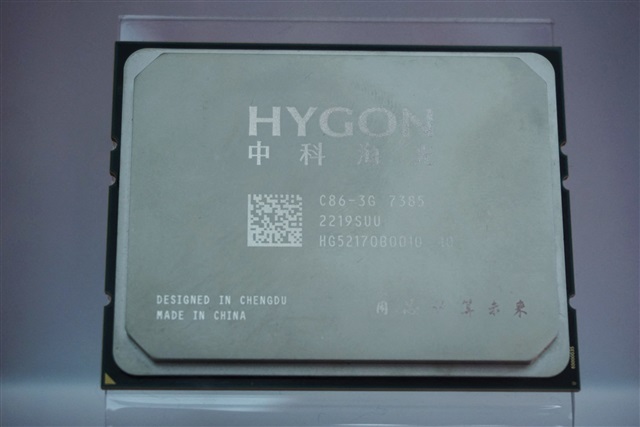
China's IT localization strategy has entered a new phase with the launch of Hygon Information Technology's C86 processor, a 4.0GHz x86-compatible chip now powering a broad lineup of domestic desktops and mobile workstations. The rollout marks a shift in China's PC market — from policy-driven deployment to performance-focused competition.
According to ICsmart and IT Home, Chinese OEMs such as Lenovo Kaitian, Unicompute, Tongfang, and ZTE launched over a dozen C86-powered desktop and mobile workstations in early July. The release signals an effort to expand beyond government-driven IT Application Innovation projects into mass-market segments like productivity, content creation, and AI computing.
Hygon's x86-based playbook: from servers to terminals
While x86 (Intel, AMD) and Arm architectures still dominate globally, China's processor ecosystem is diversifying across multiple paths: Arm-based designs (Huawei, Phytium), x86-licensed development (Hygon, Zhaoxin), homegrown instruction sets (Loongson), and open-source RISC-V (Alibaba DAMO Academy) for embedded and IoT applications.
Hygon has become a key player in China's secure infrastructure rollout, dominating the Xinchuang (innovative) server market with its C86 architecture. In 2024, Hygon reported revenue of CNY9.162 billion (approx. US$1.26 billion), up 52.4% year-over-year. In comparison, Zhaoxin earned CNY889 million, mostly from desktop and embedded chips. Phytium exceeded CNY1.9 billion in 2023, while Loongson saw a slight revenue decline to CNY504 million.
Hygon's strategy, leveraging licensed x86 IP while cultivating a local ecosystem via its "Guanghe Organization," has enabled faster scale-up than rivals. One OEM executive told ICsmart, "We've been boxed in by the 'Xinchuang' label, but aligning with global architectures like x86 and Arm is essential for broader success."
According to Hygon Vice President Wu Zongyou, the C86 terminal processor represents a strategic shift: "Our server chips moved from usable to widely deployed. With C86, we're entering a commercial terminal market that spans tens of millions of units."
Performance breakthroughs and real-world deployment
The C86 is China's first domestically built complex instruction set processor (CISC) to hit 4.0GHz. Hygon's benchmarks reveal a 15% IPC gain, 30% faster clock speed, 62% better single-core performance over domestic peers, and up to 135% multi-core uplift across 4 to 16-core variants.
The processor supports DDR5-5600, PCIe 5.0 (up to 32 lanes), USB4, and Wi-Fi 6, enabling high-speed memory and I/O. OEMs report that the 8-core C86 matches Intel's 12th-gen Core i7 and 13th-gen i5, while the 16-core version reaches parity with the 14th-gen Core i9.
In a live deployment, ThundeRobot introduced the Thunderobot G46 mobile workstation, pairing the C86 chip with Innosilicon's custom Fantasy II GPU (1.35GHz, 8GB LPDDR5x). Targeted at CAD, simulation, AI, and design workloads, the G46 features a 14-inch display, triple-pipe cooling, a fingerprint reader, a backlit keyboard, and a physical webcam shutter.
Though event images showed a 1920×1200 display and 32GB RAM, ThundeRobot's promotional specs tout a premium 2880×1800 screen with 120Hz refresh and full sRGB color, underscoring how far Chinese OEMs are pushing into high-end segments.
Efficient, secure, and ecosystem-ready
The C86 is optimized for power-sensitive use cases, with TDP starting at 15W. Power efficiency gains include a 130% boost in battery life, 27% faster wake-from-sleep, 50% lower standby consumption, and 36% higher performance-per-watt over the prior generation.
Security features include six-layer protection: hardware support for China's SM2/3/4 cryptographic standards, a Crypto Co-Processor (CCP), TRNG, tamper detection, and secure boot from on-chip ROM. The C86 is certified at China's Level II security tier.
The C86 offers native support for 32-bit and 64-bit x86 applications, avoiding the need for emulation layers. It runs tools like Photoshop, CAD platforms, and EDA suites out of the box, streamlining migration for enterprise users.
An OEM executive put it plainly: "Specs matter, but seamless software migration matters more. Hygon's performance uplift and full x86 compatibility let users move to domestic platforms without compromise."
Toward a scalable future for China's terminal market
Beyond raw specs, the C86 is engineered for ease of integration. It supports BIOS-level upgrades for reuse on existing motherboards, simplifies thermal requirements, and enables thinner devices with bigger batteries and more memory.
Hygon is also expanding its ecosystem under the "Star Sea Plan," which builds a full-stack foundation — software, testing, hardware co-design, and technical support — to accelerate product rollouts. "Terminals are more complex than chips," said Wu. "From OS vendors to chassis makers, we can't do this alone. An open ecosystem is essential."
Hygon's roadmap centers on five pillars: high performance, enhanced security, edge AI enablement, support for diverse device form factors, and full software compatibility. The company also plans to support on-device inference for large language models, anticipating broader demand for AI at the edge.
Market-driven, not just policy-led
Hygon's C86 reflects a broader shift in China's IT strategy, from policy compliance to product competitiveness. What was once a government-led market is now increasingly shaped by performance and value.
Institutional buyers are prioritizing user experience, performance-per-dollar, and software ecosystem support over policy mandates when selecting hardware.
In the consumer market, the benchmark is simple: same price, same quality, same user experience. With the C86, Hygon aims to deliver just that, positioning China's localized terminals not as fallback options, but as preferred, competitive choices.
Article edited by Jack Wu