

The competition to dominate Asia's nascent floating offshore wind market is intensifying, with Taiwan and South Korea emerging as frontrunners while Japan's cautious approach risks leaving it behind in the region's renewable energy transformation.
Industry experts and market participants say that despite the technology's high costs and infrastructure challenges, both Taiwan and South Korea are pushing ahead with ambitious floating wind projects that could reshape the region's renewable energy landscape.
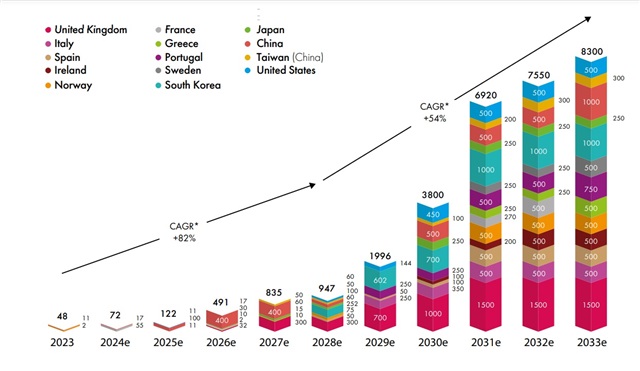
However, the path to commercialization faces significant headwinds. The Global Wind Energy Council (GWEC) has downgraded its global floating wind forecast in the Global Offshore Wind Report 2024, predicting 8.5 GW of capacity to be built globally by 2030—a 22% reduction from previous projections. The council cites several challenges, including high costs compared to fixed-bottom projects, immature technology, standardization issues, and infrastructure constraints.
New floating wind installations, Global (MW)
Credit: Global Wind Energy Council
"Taiwan's prototype projects are actually larger in scale than Japan's experimental initiatives," says a floating offshore wind developer, highlighting that Taiwan's demonstration projects could potentially reach 540MW in capacity - surpassing similar projects in neighboring countries.
Taiwan's Energy Administration is planning to launch a floating offshore wind demonstration program that would permit 6-12 floating platforms per site, with individual project capacities ranging from 90MW to 180MW. The government aims to have these projects connected to the grid by 2029-2030, although industry sources suggest the timeline might slip due to ongoing discussions about incentive mechanisms.
The initiative has attracted significant interest from international developers. "Six or seven parties are going for the bid," according to a major Japanese energy company looking to invest in Taiwan's floating wind sector.
Yet challenges remain. Taiwan's development faces hurdles including unclear policy frameworks, high investment costs, and infrastructure limitations. "We can't even calculate our business model without knowing the feed-in tariff," notes a Taiwanese developer, highlighting the uncertainty that continues to plague the sector.
Source: ResearchGate
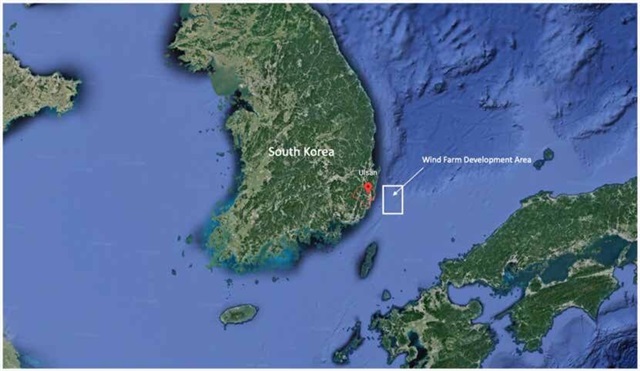
South Korea is aggressively matching Taiwan's floating wind ambitions, with Ulsan City emerging as a focal point for the nation's renewable energy transformation. Through the formation of the Ulsan Floating Offshore Wind Association in 2023, the city has created a powerful platform linking European developers with local firms and oil and gas companies, catalyzing several major projects.
The city's ambitions crystallized with the signing of letters of intent with four international consortiums to develop what could become the world's largest floating offshore wind cluster. Leading these initiatives is the Gray Whale Offshore Wind Farm, a 1.5GW project backed by SK Ecoplant in partnership with Corio and TotalEnergies, representing a KRW12 trillion (approx. US$8.3 billion) investment including KRW42.5 billion in foreign direct investment (FDI), targeted for completion by 2031.
The remaining projects showcase equally impressive scale: Norwegian state-owned Equinor's Firefly (Bandibuli) project aims to deploy 750MW by 2030 with KRW5.7 trillion investment, while Haeuli Offshore Wind Power plans a 1.5GW installation backed by KRW12 trillion. KF Wind rounds out the quartet with a 1,125MW project scheduled for 2031, supported by a KRW7.5 trillion investment.
Collectively, these projects position Ulsan to become a global leader in floating offshore wind development, with a combined planned capacity exceeding 4.8GW and total investments of over KRW37 trillion.
Credit: AFP
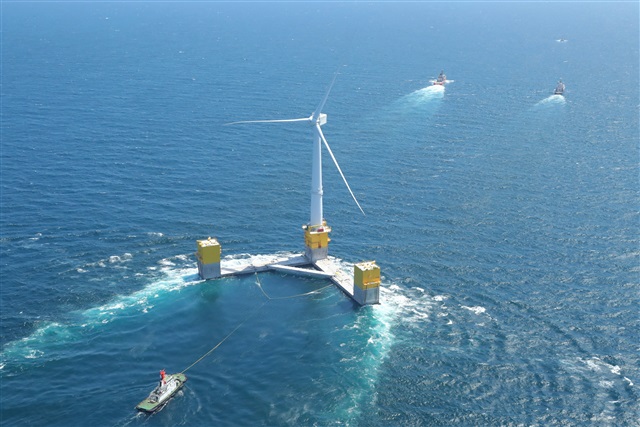
Japan's more measured approach stands in stark contrast. "Japanese are a bit slower than Korea or Taiwan," admits a Japanese renewable energy company. The country's current focus on small-scale demonstration projects - supported by a JPY85 billion (approx. US$552 million) government subsidy for two large-scale floating demonstrations - suggests a more cautious strategy.
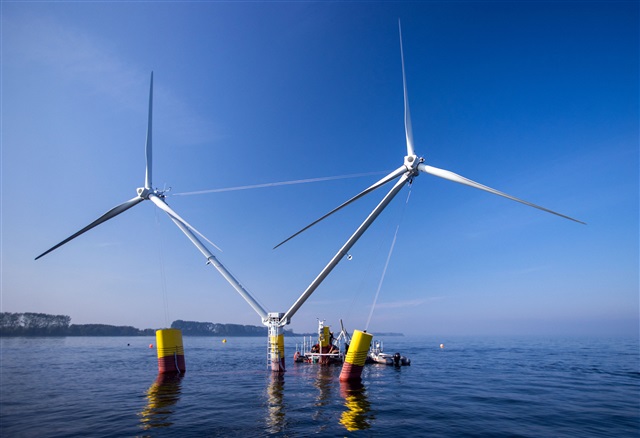
For Japan, the strategic shift towards smaller demonstration projects following the Fukushima FORWARD project - once one of the world's earliest floating wind initiatives - raises questions about its ability to compete in the increasingly crowded market. "Now we are going back to the prototype again," the Japanese executive explains, suggesting that Japanese companies might need to gain experience through overseas projects before re-entering their domestic market.
Despite this conservative approach, Japan is laying the groundwork for future development. According to GWEC, the government passed an amendment allowing floating wind farms in its Exclusive Economic Zone (EEZ) and established the Floating Offshore Wind Technology Research Association (FLOWRA). The initiative is backed by JPY 4 billion in direct support and up to JPY 400 billion in green transformation bonds for supply chain development.
Credit: AFP
As the region's floating wind sector evolves, the competition for supply chain dominance remains open. While some developers are exploring local procurement options, others maintain flexibility in sourcing components. "Supply chain could be anywhere... Korea, Japan, Taiwan, Indonesia, Vietnam," says a foreign representative, indicating that cost competitiveness rather than national origin will likely determine supplier selection.
The next five years will be crucial in determining which Asian nation emerges as the floating wind leader. With Taiwan and South Korea's accelerated timelines contrasting with Japan's methodical approach, the race to commercialize floating wind technology could reshape the region's renewable energy landscape - and with it, the balance of power in Asia's green energy transition.