Taipei, Saturday, May 25, 2013 05:08 (GMT+8)
partly cloudy
Taipei
24°C
Digitimes Insight: Limited wafer availability good for DRAM industry
Nobunaga Chai, DIGITIMES Research, Taipei [Monday 21 March 2011]

With major silicon wafer plants remaining closed following the recent earthquake and tsunami that struck Japan, there is growing concern in the memory industry whether chip companies are preparing for any possible disruption to production.

Potential wafer supply disruptions may actually push the memory industry, especially the DRAM sector, to reach a balance between supply and demand. There has been a substantial rise in DRAM supplies since the second half of 2010.

Digitimes Research previously forecast that the DRAM industry would be dogged by oversupply as chipmakers ramp up output through conversions to new technology nodes. Worldwide DRAM supply would exceed demand by 28% in 2011, according to estimates made in January 2011.

Major DRAM producers plan to grow their capacity for 2011 between 40% and 70%, with any of their output growth expected to outpace the rise in overall demand.

As for NAND flash, a short supply of silicon wafers would just soften chipmakers' efforts to increase their capacity in 2011. Major NAND-chip producers including Samsung Electronics, Toshiba and Hynix are all gearing up to enter the 20nm-class technology era in 2011. Samsung, Toshiba and Micron Technology are also looking to implement their new fab plans.

Despite concerns about wafer supply disruptions caused by the earthquake, the NAND flash industry is still expected to see its overall bit growth reach 78% in 2011 to 9.33 billion GB.

Shin-Etsu Handotai's (SEH) main silicon wafer plant in Fukushima Prefecture remains closed with no time-frame for when it will re-open, according to parent company Shin-Etsu's latest statement about SEH's business status following the earthquake. Monthly capacity at the facility accounts for more than 60% of SEH's overall production capacity.

Sumco has been less affected due to its main factory sites being located away from quake-hit areas. Production at its damaged plant in Yamagata Prefecture has been shifted to other plants in the Kyushu region, according to Sumco's most recent status update.
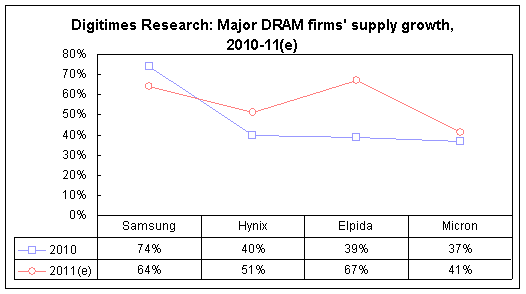
Digitimes Research: Major DRAM firms' supply growth estimate, 2011

Source: Digitimes Research, March 2011

24-May-2013 markets closed

 LastChange

TAIEX (TSE)8209.78-28.05-0.34% 

TSE electronic310.89-0.43-0.14% 

GTSM (OTC)118.64-0.71-0.59% 

OTC electronic143.77-0.29-0.2% 

InnoDisk products: SSD
Trends and forecast for 2013 touch panel market
Trends in China LED chip and packaging sector
  • Samsung reportedly to outsource more chips

    Samsung Electronics reportedly is looking to expand the purchase of memory products, including mobile DRAM chips and eMMC NAND devices, from outside.

  • Micron reaches deal to acquire Elpida

    Micron Technology and Elpida Memory's trustees have reached an agreement for Micron to acquire Elpida. Micron also announced a separate agreement with...

  • Taiwan DRAM firms mull fab sales

    Taiwan-based DRAM chipmakers including Powerchip Technology and ProMOS Technologies are considering selling fabs in order to preserve cash and strengthen...

  • Samsung foundry biz expanding

    Specializing in the manufacture of memory chips and LCD panels, Samsung's component operations are undergoing a focus shift to advanced process design...

  • Trends and shipment forecast for 2H 2012 tablet market

    Digitimes Research remains conservative about the prospects for the period, with half-year shipments projected to reach 49.18 million units and whole-year shipments being revised downward to 88.69 million units.

  • Trends in the China video market

    In addition to strong potential video content demand in China, the market has developed rapidly due to government intervention and delays in establishing copyright protections.

  • 4Q12 trends in the Greater China touch panel industry

    In the second half of 2012, the market focus is on the iPhone 5, which uses in-cell touch screen technology. Due to the integration of display panels and touch panel functions, the high technological threshold will mean Taiwan touch panel makers are unable to enter the iPhone supply chain.