

One Laptop per Child (OLPC) announced that work is already underway on a second- generation version of its XO notebook computer. Leveraging new advances in technology, the primary goal of the XO-2 will be to advance new concepts of learning as well as to further drive down the cost of the laptop so that it is affordable for volume purchase by developing nations, according to OLPC.
The first generation XO notebook went into production in early November 2007, and there are approximately 600,000 units in deployment in a number of countries including Peru, Uruguay, Mongolia, Haiti, Rwanda, Mexico, Cambodia, Ethiopia, Ghana, Iraq, Afghanistan, and the US and Canada.
Set in early 2005, the original target price of the XO notebook was US$100. Although that target has not yet been met, it is clear that OLPC must aim for an even lower target price of US$75. New developments in display, processor and other hardware and software technologies will make it possible to achieve the US$75 target in the future, noted the organization.
While the first generation XO notebook already requires just one-tenth of the electrical power necessary to run a standard notebook, the XO-2 will reduce power consumption even further to one watt. This is particularly important for children in remote and rural environments where electricity is scarce or non-existent. Lowering the power consumption will reduce the amount of time required for children to generate power themselves via a hand crank or other manual mechanisms.
The XO-2 notebook will be about half the size of the first generation device and will approximate the size of a book. The new design will make the XO notebook lighter and easier for children to carry with them to and from school or wherever they go. The XO-2 will continue to be in a green and white case and sport the XO logo in a multitude of colors that allow children to personalize the notebook as their own possession.
Dual-touch sensitive displays will be used to enhance the e-book experience, with a dual-mode display similar to the current XO notebook. The design provides a right and left page in vertical format, a hinged notebook in horizontal format, and a flat two-screen wide continuous surface that can be used in tablet mode. Younger children will be able to use simple keyboards to get going, and older children will be able to switch between keyboards customized for applications as well as for multiple languages. The dual-touch display is being designed by Pixel Qi, which was founded in early 2008 by Mary Lou Jepsen, former chief technology officer of One Laptop per Children and a leading expert on display technology.
Availability of the XO-2 is planned for delivery in 2010. XO-1.5 will be released in the spring of 2009 with the same design as the first generation but with fewer physical parts and at a lower cost than XO-1.
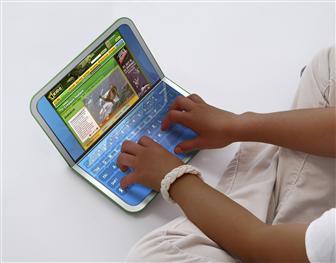
OLPC XO-2 notebook
Photo: Business Wire

